
The Complete Grant FAQs for Nonprofits: 199 Expert Answers from Diane Leonard, GPC
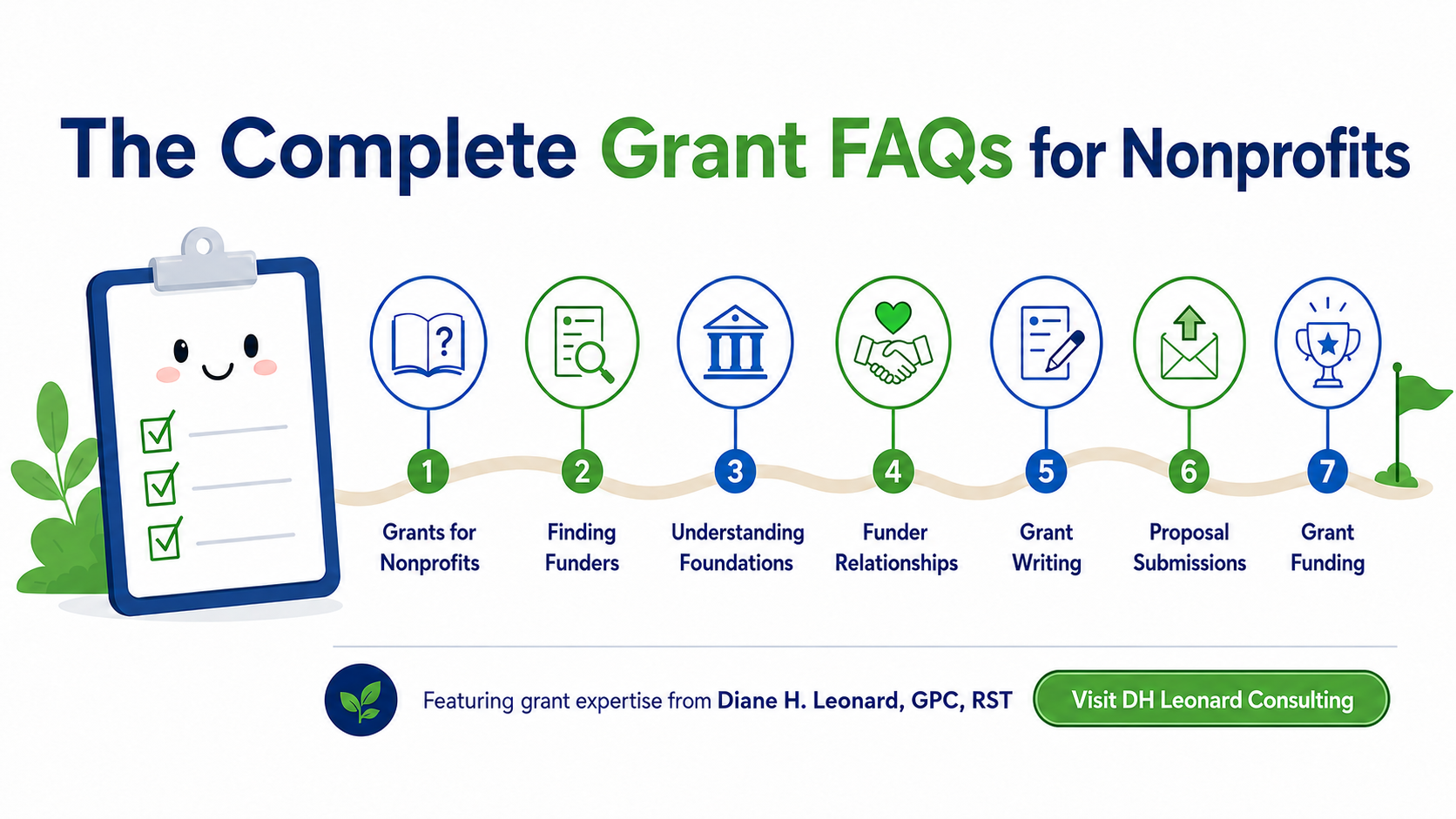
The Complete Grant FAQs for Nonprofits gathers 199 expert answers to the most-searched questions about grants for nonprofit professionals — drawing on two decades of practical experience teaching grant writing, funder research, and proposal strategy.
Grant Writing
🎁 Gift this free resourceHow to write compelling, competitive grant proposals.
27 QUESTIONS
What is grant writing for nonprofits?
Grant writing for nonprofits is the process of preparing a formal funding request to a foundation, corporation, or government agency on behalf of a 501(c)(3) organization. The work goes well beyond writing — it includes assessing grant readiness, researching best-fit funders, building relationships with grantmakers, designing a competitive project narrative, preparing a budget, and submitting a polished application before the deadline. Grant professionals also manage reporting and stewardship after an award is made.
At CharityHowTo, Diane Leonard, GPC, teaches that strong grant writing is grounded in the full grant lifecycle, not just the writing itself. The grant lifecycle — readiness, research, relationships, application, reporting — is the foundation that makes individual proposals competitive in an increasingly crowded funding environment.
How do I start writing a grant proposal?
The first step in writing a grant proposal is to confirm your eligibility and fit with the funder, not to start drafting. Before any narrative is written, the grant lifecycle calls for four sequential steps: confirm grant readiness, research best-fit funders, build a relationship or initial contact with the grantmaker where possible, and only then begin to outline the application.
Diane Leonard, GPC, teaches a four-part outlining process inside step four: identify what you already have (program design documents, logic model, budget, similar past narratives), identify what the funder requires (sections, character limits, attachments), identify the gaps and request that information from program staff or finance, and build a submission timeline that targets a date earlier than the actual deadline.
What are the main sections of a grant proposal?
A grant proposal typically includes a cover letter, executive summary or project abstract, organizational background, statement of need, project description with goals and SMART objectives, methods and activities, evaluation plan, sustainability section, budget with justification, and required attachments such as IRS determination letter, audited financials, board list, and letters of support. The exact combination is set by the grantmaker, not by the applicant.
Foundation applications are often submitted through an online portal with specific questions; federal applications follow a defined structure governed by the funding opportunity announcement. In every case, the required elements are at the grantmaker's discretion — your job as the writer is to follow their guidelines exactly.
How do I write a strong needs statement for a grant?
A strong needs statement defines the problem you are addressing using data specific to the community you serve, not generic national statistics. Reviewers already know there is need; what they want is evidence of why the need exists in your community and what is happening if it goes unaddressed. The most competitive needs statements connect community-level data to the funder's stated priorities.
Diane Leonard teaches that the needs statement should not be a contest about who has the greatest tale of woe. Instead, the goal is to position your organization as the expert best equipped to address the need, using data to support that authority rather than to amplify desperation.
How do I write a grant proposal executive summary?
A grant proposal executive summary should answer four questions in whatever space the funder allows: how much you are requesting, what project the funding will support, what need it addresses, and why your organization is the right one to deliver the work. When the executive summary is short — sometimes a single sentence — focus on dollar amount, program name, and projected impact, and reserve organizational expertise for later sections.
Diane Leonard cautions against using acronyms in the executive summary. Reviewers may not have read the rest of the application yet, and acronyms force them to work harder. Avoid copy-pasting from prior applications; the executive summary is often the first thing read and signals whether the rest of the proposal is worth the reviewer's time.
What should a grant cover letter include?
A grant cover letter should include the funder's name and address spelled correctly, the dollar amount requested, the program or project name, a sentence on why your missions align, and a reference to any prior contact you have had with the funder. It should also clearly identify who the funder should contact with programmatic questions if that is someone other than the signatory.
Diane Leonard compares the cover letter to a job application cover letter: a customized cover letter signals that the applicant cares about the specific employer, while a generic one signals they sent the same letter to fifty other places. Funders are looking for that same signal. References to prior contact ("It was great to meet you at the Funder Forum last week") are particularly powerful because they reinforce relationship.
What is a logic model and do I need one for grants?
A logic model is a one-page visual that maps the resources, activities, outputs, outcomes, and impact of a program from left to right, like a conveyor belt. Resources are the things that cost money (people, space, equipment, supplies), activities are what you do with those resources, outputs are what you can count, outcomes are the changes in behavior, knowledge, or skill, and impact is the long-term result. Many federal and large foundation funders require a logic model; even when not required, having one strengthens narrative writing.
Diane Leonard teaches that the logic model is most valuable as a facilitation tool — a way to get program staff, finance, and leadership to a shared understanding of what is actually being proposed. From there, the logic model becomes the blueprint that narrative sections, budget justifications, and evaluation plans are built from.
What is a theory of change in grant writing?
A theory of change is a statement or visual that explains the logic of why your organization does what it does — if we do this, then we will get this result. A basic theory of change uses a single strategy; a multi-strategy theory of change describes how multiple strategies combine to produce one or more results. The theory of change operates at a higher altitude than a logic model — Diane Leonard describes the logic model as the 10,000-foot view and the theory of change as the 30,000-foot view.
Theory of change matters for grant writing because grantmakers want to understand the philosophical "why" behind your work, not just the operational "what." A strong theory of change connects your daily activities to the broader change your organization believes is possible in the world.
How long should a grant proposal be?
A grant proposal should be exactly as long as the funder specifies and not one word longer. Foundation applications increasingly use online portals with hard character or word limits per field — sometimes as few as 250 characters for what is labeled an "executive summary." Federal applications follow page limits defined in the funding opportunity announcement.
Diane Leonard teaches that working within tight character limits is a competitive skill, not a constraint to fight against. The discipline of saying more with fewer words signals to reviewers that you understand the funder's process and respect their time. Going over a stated limit can disqualify an application regardless of content quality.
How do I tailor a grant proposal to each funder?
Tailoring a grant proposal to each funder requires more than swapping the grantmaker's name and adjusting character counts. The story of your work needs to be rewritten through the lens of that funder's mission, funding priorities, and stated goals. Two foundations funding the same program area will respond to the same project described in noticeably different ways depending on how the alignment with their priorities is framed.
Diane Leonard recommends approaching every grantmaker from a fresh perspective — starting with a clean screen rather than yesterday's draft. A narrative library of previously approved language is useful as a reference, but every application should be considered as its own customized story for that specific funder.
What makes a grant proposal stand out in 2026?
A grant proposal stands out in 2026 by being submitted early, customized to the specific funder, supported by an existing relationship with the grantmaker, and clearly aligned with that funder's stated priorities. With application volume at historic highs and AI making it easier than ever to produce a baseline draft, the differentiators are relationship, timing, customization, and authentic voice.
Diane Leonard notes that her team's grant word for 2026 is "relationships." Foundations are reporting record application volumes, some are closing portals early once a certain number of applications are received, and others have moved to invitation-only. In that environment, name recognition, prior contact, and authentic alignment with the funder's mission matter more than they ever have.
What is the success rate for grant proposals?
The commonly cited national success rate for grant proposals is approximately 10%, meaning roughly one in ten applications receives funding. Success rates vary substantially by funder type, application strength, and how well the applicant matches the funder's priorities — strong fit and relationship can push success rates much higher, while applying broadly to ill-matched funders can drag them well below average.
Diane Leonard reminds grant writers that even technically perfect applications often go unfunded, simply because there are always more strong proposals than there are dollars available. A rejection is not necessarily a sign of a weak proposal; it is often a sign that the funder had to choose among many good options.
Should we use AI to write grant proposals?
Whether to use AI to write grant proposals is a question every nonprofit needs to answer through an explicit organizational AI use policy, not on a case-by-case basis. Funders are increasingly asking applicants to disclose whether and how AI was used, so organizations need an agreed-upon answer before that question appears.
Diane Leonard's strongest recommendation for nonprofits in 2026 is to develop an AI use policy that addresses grant writing and related work before worrying about which specific tools to use. The right policy depends on the organization's values, the sensitivity of the information involved, and the funder's expectations. Using AI to brainstorm or edit is different from using AI to generate full narratives, and an organization should know where it stands before a deadline forces a quick decision.
What is grant readiness?
Grant readiness is the assessment of whether an organization is eligible and competitive for a particular funding opportunity before any time is spent on a proposal. Readiness includes 501(c)(3) status, financial stability evidenced by audited financials, organizational governance, program design documents, the geographic and population alignment with the funder's priorities, and any specific eligibility requirements stated in the guidelines.
Diane Leonard teaches grant readiness as the first step in the grant lifecycle — the 12 o'clock position on the lifecycle clock — because readiness determines whether the application is worth pursuing at all. Readiness means something different for foundation grants, city and state grants, and federal grants; each tier has its own threshold of organizational documentation, financial capacity, and compliance infrastructure.
How do I tell my organization's story in a grant application?
Telling your organization's story in a grant application means using the entire application — cover letter through attachments — as a single coordinated narrative, not just inserting an anecdote into the needs statement. Storytelling in grants is technical writing, not creative writing; the goal is to portray your organization as the expert best positioned to address the need, supported by data, mission alignment with the funder, and clear program design.
Diane Leonard teaches that the story is built around the person reading the application. That person — a program officer, a reviewer, a board member of the funder — is the one your story needs to connect with, because they are the one who will advocate for your proposal in the funding decision. Storytelling earns that advocacy by making the case feel both rigorous and human.
What's the difference between writing a foundation grant and a government grant?
The difference between writing a foundation grant and a government grant is that foundation grants reward alignment with a specific funder's mission and relationships with the program officer, while government grants reward alignment with stated policy goals, technical compliance, and competitive scoring against a published rubric. Foundation applications tend to be narrative-driven; government applications tend to be section-driven with strict formatting and required forms.
Diane Leonard notes that the underlying work — who you are, what you do, the need you address — stays the same across both. What changes is the framing. Foundation narratives connect your work to the funder's mission statement; government narratives connect your hands-on work to the policy goals and purpose stated in the funding opportunity.
What documents do I need to apply for grants?
To apply for grants, a nonprofit typically needs its IRS 501(c)(3) determination letter, most recent 990 tax form, audited financial statements, organizational and project budgets, board of directors list with affiliations, mission and vision statements, strategic plan, logic model or theory of change, program design documents, evaluation plan, key staff resumes or bios, and letters of support from partner organizations.
Diane Leonard recommends preparing these documents as a permanent "grant readiness" library so that they are not being scrambled together at the last minute for every application. When a deadline appears, the writer's time should be spent on customizing the narrative — not chasing down a board roster or last year's audit.
What are SMART objectives in a grant proposal?
SMART objectives in a grant proposal are objectives that are Specific, Measurable, Achievable, Relevant, and Time-bound. A strong SMART objective replaces a vague aspiration ("improve youth literacy") with a specific commitment ("by August 31, 2026, 80% of enrolled third-graders will demonstrate at least one grade-level improvement in reading assessment scores"). SMART objectives anchor the project description, the evaluation plan, and the eventual reporting.
Diane Leonard teaches SMART objectives as part of a broader program design framework that also includes goals (broad and aspirational), objectives (SMART), activities, outputs (countable), outcomes (changes in behavior or knowledge), and impact (long-term result).
What's the difference between outputs and outcomes in grants?
The difference between outputs and outcomes in grants is that outputs are the countable results of your activities, while outcomes are the changes those activities produce. Outputs answer "what happened that we can count" — number of meals delivered, number of people served, number of training sessions held. Outcomes answer "what changed as a result" — reduction in food insecurity, improvement in health markers, increase in skills or knowledge.
Diane Leonard uses a hot meal delivery program as an illustrative example: the output is the number of hot meals delivered and the number of people served, while the outcomes include reduced food insecurity and improved participant health. Funders generally want both, but outcomes are what justify continued funding.
Should I hire a grant writer or do it in-house?
Whether to hire a grant writer or keep the work in-house depends on capacity, the complexity of the funding you are pursuing, and the strategic value of building grant skills inside your organization. A skilled external grant writer brings experience and capacity but is one more cost to manage; an in-house writer builds institutional knowledge but takes time to develop. Many organizations use a hybrid model — internal staff for foundation grants and consultants for large federal proposals.
Diane Leonard's consulting team works alongside organizations every day, which informs her teaching: grant writing is a learnable skill, but it requires consistent practice and exposure to many different funder requirements to develop. For an organization just beginning to pursue grants, partnering with an experienced writer for the first several applications while staff observe and learn is often the strongest approach.
How early should I submit a grant application?
A grant application should be submitted as far in advance of the deadline as possible — not on the deadline date. Grantmakers face higher application volumes than ever, and some foundations now close portals once they receive a set number of applications, sometimes without notice. The competitive advantage of an early submission has shifted from "nice to have" to "necessary."
Diane Leonard's team tracks the number of days in advance of the deadline each client application is submitted, and treats that number as a quality metric. Submitting early reduces stress, allows for more thorough review, and protects against last-minute portal closures or technical issues. When a funder announces a deadline with a possible early cap, the operative question is no longer "when is this due" but "how fast can we get a high-quality application in their hands."
What is project management for grant writing?
Project management for grant writing is the process of organizing the people, deadlines, and deliverables required to produce a competitive grant application on time. A grant application is a multi-stakeholder project: the writer drafts narrative, the program team supplies project details and logic, finance produces the budget, leadership reviews and approves, and operations supplies required attachments. Without clear project management, deadlines slip and quality suffers.
Diane Leonard recommends choosing a project management approach that works for your team — sticky notes, Asana, Trello, ClickUp, or any other tool — and using it consistently. The specific tool matters less than the transparency it creates. Everyone on the grant team should know what their role is, what they owe by when, and how their piece fits into the final submission.
Who should be on my grant writing team?
A grant writing team typically includes the grant writer or grant professional, a member of the program team who knows the project deeply, a finance representative who can produce the budget, an executive sponsor (usually the executive director or CEO) who signs the application, and a designated reviewer who is not the writer. Larger organizations may add a development director, a board liaison, and a partnership coordinator.
Diane Leonard emphasizes that grant writing is rarely the work of one person. Even when there is a single dedicated grant writer, that person is dependent on the program team for content, finance for budgets, and leadership for sign-off. Treating the grant team as a true team — with shared deadlines, shared accountability, and shared credit for awards — produces stronger applications and reduces burnout on the writer.
What are the most common reasons grant proposals get rejected?
The most common reasons grant proposals get rejected are weak alignment with the funder's stated priorities, failure to follow the funder's instructions exactly, lack of evidence of community need or organizational capacity, missing or incomplete attachments, late submission, and absence of any prior relationship with the funder. Many rejections are not about writing quality at all — they are about fit.
Diane Leonard adds that with application volumes at record highs, rejection often comes down to a tie-breaker the applicant cannot see. In a stack of 250 strong applications, the funded ones are frequently those whose authors had prior contact with the grantmaker, whose names the program officer recognized, or whose alignment with the funder's mission was unmistakable from the cover letter onward.
How do I follow up after submitting a grant proposal?
Following up after submitting a grant proposal starts with sending a brief confirmation thank-you to the program officer (when contact information allows), then waiting until the funder's stated decision timeline has passed before reaching out again. If declined, request feedback when the funder offers it, treat the response with professionalism regardless of the outcome, and ask whether reapplication in a future cycle would be welcomed.
Diane Leonard teaches that the response to a rejection is a critical relationship moment. A gracious, professional reply to a declination — with no defensiveness — leaves the door open for a future award. A defensive or pushy response can close it permanently. Some of her team's largest awards have come from second or third applications to funders who initially declined.
Do I need 501(c)(3) status to apply for grants?
501(c)(3) status is required for the majority of foundation and government grants in the United States, though some funders accept applications from organizations operating under a fiscal sponsor with 501(c)(3) status. Faith-based organizations, schools, and government entities have additional pathways depending on the funder. Always confirm eligibility against the funder's stated requirements before investing time in an application.
For nonprofits in formation, securing a fiscal sponsor is a common route to grant eligibility while 501(c)(3) status is pending. The fiscal sponsor receives the funds and disburses them under their tax-exempt umbrella, in exchange for an administrative fee.
How do I handle a tight grant deadline?
Handling a tight grant deadline starts by quickly assessing whether the application is worth pursuing — fit and competitive readiness still apply even when time is short. If the decision is yes, immediately gather the funder's requirements, identify what content you can pull from existing materials (logic model, prior narratives, budget templates), and identify what gaps require input from finance or program staff.
Diane Leonard's four-step approach scales down for tight deadlines: what do I have, what does the funder need, what's missing and from whom, and what is the fastest realistic path to a high-quality submission. The key word is "high-quality" — submitting a weak application against a tight deadline is rarely a better use of time than declining and pursuing a better-fit funder with more runway.
Grant Funding
🎁 Gift this free resourceTypes of grants, funding sources, and how grant funding works.
30 QUESTIONS
What is a grant for a nonprofit?
A grant for a nonprofit is a sum of money awarded by a foundation, corporation, or government agency that does not have to be repaid. Grants are typically restricted to a specific project, program, or operational purpose defined by the funder, and the nonprofit agrees to use the funds accordingly and to report back on outcomes. Unlike individual donations, grants involve a formal application process and a written agreement governing how the funds are used.
Grants come with the expectation of stewardship — the nonprofit is accountable not only for spending the funds appropriately, but for demonstrating the impact the funds produced. Diane Leonard, GPC, teaches that grant funding is part of a broader grant lifecycle that includes readiness, research, relationships, writing, and reporting; the grant itself is only one stage of that cycle.
What types of grants are available for nonprofits?
The main types of grants available for nonprofits are foundation grants (private, community, corporate, and family foundations), government grants (federal, state, county, and city), and corporate grants from companies' direct giving programs. Within those categories, grants are also classified by purpose: program or project grants, general operating support grants, capacity-building grants, capital grants, research grants, and seed or startup grants.
Each grant type has different application processes, reporting requirements, and competitiveness. Federal grants are typically the largest in dollar amount but require the highest level of organizational readiness; foundation grants vary widely; corporate grants often emphasize community impact in geographic areas where the company operates.
How do grants work for nonprofits?
Grants work for nonprofits in a four-stage cycle: the nonprofit identifies a funder whose priorities align with its work, submits a formal application or letter of inquiry, receives an award (or denial) decision, and then implements the funded project while reporting back to the funder on progress and outcomes. Most grants are restricted to a specific use defined in the application, and the nonprofit signs a grant agreement before funds are released.
Diane Leonard teaches that the most overlooked part of how grants work is what happens before the application — grant readiness, funder research, and relationship-building. Strong grant work isn't about writing better proposals in isolation; it's about doing the upstream work that makes any individual proposal much more likely to win.
What is the difference between a foundation grant and a government grant?
The difference between a foundation grant and a government grant is that foundation grants are awarded by private nonprofit entities (private foundations, community foundations, corporate foundations) based on alignment with the foundation's mission and often with the program officer's recommendation, while government grants are awarded by federal, state, or local agencies based on competitive scoring against published criteria and stated policy goals.
Foundation grants tend to be more narrative-driven and reward relationship and mission alignment; government grants tend to be more structured and reward technical compliance, evidence-based programming, and clear policy alignment. Diane Leonard teaches that an organization's underlying work stays the same when applying to both — what changes is how the story is framed.
What is a federal grant?
A federal grant is funding awarded by a department or agency of the United States federal government — such as the Department of Health and Human Services, the Department of Education, the Department of Justice, the Environmental Protection Agency, or many others — to support work that aligns with the agency's stated policy goals. Federal grants are listed on Grants.gov, the central federal grant portal, and applied to through that portal.
Diane Leonard teaches federal grants as their own specialized category because of the elevated readiness requirements. To apply for federal funding, an organization needs registrations in SAM.gov and Grants.gov, an Authorized Organization Representative (AOR), audited financial statements, indirect cost rate documentation in many cases, and capacity to manage federal compliance and reporting.
Are nonprofit grants taxable?
Nonprofit grants are generally not taxable income for the receiving 501(c)(3) organization because tax-exempt nonprofits are not subject to federal income tax on activity related to their exempt purpose. However, certain grant funds may have tax implications depending on how they are used, particularly if they support unrelated business activity. Organizations should consult with a qualified nonprofit accountant on specific situations.
For individuals receiving grants (rare for general nonprofit grants but common for fellowships, scholarships, and research awards), tax treatment depends on the type of grant and how the funds are used.
Do grants need to be repaid?
Grants do not need to be repaid in the normal course of a successful grant. That is what distinguishes a grant from a loan — once awarded and properly used, the funds are not returned. However, grants typically come with conditions: the nonprofit must use the funds for the purpose specified in the grant agreement, must report on use and outcomes, and must comply with the funder's requirements.
If a nonprofit misuses grant funds, fails to deliver on what was promised, or violates the grant agreement, the funder may require return of some or all of the funds. This is rare but reinforces why grant stewardship and accurate reporting matter.
What is a restricted vs. unrestricted grant?
A restricted grant is funding that must be used for the specific project, program, or purpose defined by the funder in the grant agreement. An unrestricted grant, also called general operating support, can be used for any purpose that advances the nonprofit's mission — including overhead, staff salaries, rent, technology, and operational expenses. Unrestricted funding is harder to find but extraordinarily valuable because it gives the organization flexibility.
Most foundation and government grants are restricted. Unrestricted funding is more common from individual donors, but a growing number of foundations now offer general operating support grants — particularly to organizations they have funded successfully in the past.
What is general operating support?
General operating support is unrestricted grant funding that a nonprofit can apply to any aspect of its operations — staff salaries, rent, technology, infrastructure, professional development, fundraising costs, or program work. It is sometimes called core support, operating funding, or unrestricted funding. General operating support is widely considered the most valuable type of grant because it lets the organization deploy resources where they are most needed.
Operating support grants are harder to secure than program-specific grants because funders historically wanted their dollars tied to a defined deliverable. The trust-based philanthropy movement has shifted that posture somewhat, with more funders now offering operating support to organizations they trust.
What is a capacity-building grant?
A capacity-building grant is funding specifically designed to strengthen a nonprofit's internal operations rather than to fund direct programs. Typical capacity-building grants support technology upgrades, staff training, strategic planning, fundraising infrastructure, evaluation systems, board development, or organizational assessments. The premise is that a stronger organization will deliver stronger programs over time.
Capacity-building funding is particularly valuable for small and mid-sized organizations that don't have the resources to invest in infrastructure out of their operating budgets. Many community foundations and corporate foundations offer capacity-building grants as part of their regular giving programs.
What is a multi-year grant?
A multi-year grant is funding that commits the funder to support the nonprofit over multiple budget years, typically two to five years, rather than a single year. Multi-year grants provide budget stability, reduce the time the nonprofit spends reapplying every year, and signal a deeper funder commitment. They typically require annual reporting and may include reduced funding in later years.
Diane Leonard notes that the appeal of multi-year grants is one of the top reasons organizations pursue federal funding — federal awards often run three to five years, which feels far more sustainable than annual foundation cycles. Multi-year foundation grants exist but are typically reserved for funders' highest-trust grantees.
What is a capital grant?
A capital grant is funding restricted to a major, often one-time investment in physical infrastructure — building construction or renovation, land acquisition, vehicle purchase, equipment installation, or technology buildout. Capital grants are typically larger than program grants and often require matching funds from the nonprofit's own fundraising. They support assets that will deliver value over many years.
Capital grants frequently come from family foundations, community foundations with capital programs, government infrastructure funding, or capital campaigns supported by major donors. The application process tends to focus heavily on financial sustainability — funders want to know the nonprofit can operate and maintain the asset after the capital investment is made.
What is a project grant vs. a program grant?
A project grant supports a specific activity with a defined beginning and end — a one-time initiative, an event, a research study, a pilot program. A program grant supports an ongoing area of work the nonprofit delivers continuously, such as afterschool tutoring, food distribution, or housing services. The line between the two is sometimes blurry; funders use both terms.
Both project and program grants are restricted funding — the dollars must be used for the specific work described in the application. Many funders prefer to fund discrete projects because outcomes are easier to measure within a defined time frame.
What is grant readiness for federal grants?
Grant readiness for federal grants is the set of organizational capabilities, registrations, and documentation required before an organization can compete for federal funding. The bar is substantially higher than for foundation grants. Federal readiness includes SAM.gov and Grants.gov registration, a Unique Entity Identifier (UEI), an Authorized Organization Representative (AOR), audited financial statements (often required annually), federally negotiated or de minimis indirect cost rate documentation, capacity to manage federal compliance, and the staff and systems to handle federal reporting requirements.
Diane Leonard teaches that an organization ready for federal grants is ready for everything else. The readiness threshold for federal funding sets a high bar; meeting it positions the organization for the full range of funding opportunities including state, county, city, and foundation grants.
What is SAM.gov?
SAM.gov is the System for Award Management — the federal government's central registration system for entities that wish to do business with the U.S. government, including applying for federal grants. Registration in SAM.gov is required before an organization can submit a federal grant application. The registration includes basic organizational information, a Unique Entity Identifier (UEI), and certifications related to federal requirements.
SAM.gov registration is free but takes time, particularly for organizations registering for the first time. Diane Leonard recommends starting the registration process well in advance of any federal application deadline because the process can take weeks and sometimes encounters technical issues. She also recommends calling the SAM.gov help desk early and often when problems arise — the help desk does escalate issues when needed.
What is Grants.gov?
Grants.gov is the central online portal where federal grant opportunities are posted and where federal grant applications are submitted. Every department and agency of the U.S. federal government posts funding opportunities on Grants.gov, and organizations search, save, and apply through the portal. Grants.gov has a free Learn Grants tab with guidance on navigating the federal grant system.
Diane Leonard recommends signing up for the simpler.grants.gov newsletter, which announces improvements to the federal grant portal and offers free community demonstrations of new features. The portal continues to evolve, and staying current on changes is part of grant readiness.
What is an Authorized Organization Representative (AOR)?
An Authorized Organization Representative (AOR) is the person at a nonprofit who is legally authorized to submit federal grant applications and sign federal grant agreements on the organization's behalf. The AOR is typically the CEO, executive director, or president — someone at the top of the organizational chart who has legal authority to commit the organization to the terms of a grant.
Some organizations designate multiple AORs to provide redundancy — a CFO or COO may also hold AOR status in addition to the CEO. Diane Leonard emphasizes that the AOR designation is consequential: this is the person legally bound by what the organization says yes to in a federal grant application.
Where does grant funding come from?
Grant funding comes from four main sources: private foundations (including family foundations, independent foundations, and operating foundations), community foundations (which pool donations from many donors in a specific geographic area), corporate foundations and corporate giving programs, and government agencies at the federal, state, and local levels. Each source has different priorities, application processes, and reporting expectations.
The largest absolute dollars typically come from federal agencies and major private foundations. The most accessible dollars for small and mid-sized nonprofits often come from community foundations and local corporate giving programs, which prioritize organizations in their geographic service area.
What is a community foundation?
A community foundation is a public foundation that pools contributions from many donors to make grants supporting a specific geographic area — typically a city, county, or region. Community foundations hold donor-advised funds, designated funds, and unrestricted funds, and make grants to local nonprofits across diverse mission areas. They are often the most accessible foundation funder for small and mid-sized local nonprofits.
Building relationships with the community foundations in your geographic service area is one of the highest-return activities a nonprofit grant seeker can pursue. Diane Leonard's relationship-first philosophy applies particularly strongly to community foundations, where program officers often know local organizations well and value direct contact with applicants.
What is a family foundation?
A family foundation is a private foundation funded primarily by a family's wealth and governed by family members, sometimes with additional non-family trustees. Family foundations range from very small (a few thousand dollars in annual giving) to very large (hundreds of millions). Their priorities often reflect the founding family's personal interests and values, and many do not accept unsolicited proposals — operating instead by invitation only.
Family foundations are most accessible through relationships. Board connections, mutual contacts, peer organizations who have been funded, and program officer outreach are typical paths in. Cold applications to family foundations have a notably low success rate compared with foundations that have open application processes.
What is a corporate foundation grant?
A corporate foundation grant is funding from a foundation established by a for-profit company, typically to support communities where the company operates and causes aligned with the company's brand. Corporate foundations are legally distinct from the company itself but are funded primarily by it. Examples include the Bank of America Charitable Foundation, the Walmart Foundation, and the Wells Fargo Foundation.
Corporate foundation grants often have specific geographic priorities (cities or regions where the company has a significant presence), align with the company's strategic interests (small business, financial health, education, sustainability, racial equity), and may include opportunities for employee engagement or volunteer matching. Corporate grants are sometimes accompanied by sponsorship opportunities and other relationship benefits.
How much of a nonprofit's budget should come from grants?
A nonprofit's budget should not depend too heavily on any single funding source, including grants. Best practice in nonprofit financial sustainability calls for a diversified revenue mix — typically grants, individual donations, earned revenue, events, and corporate support — so that the loss of any single source does not threaten the organization. The right grant percentage varies widely by organization type: research institutes and federally funded service providers may be 70%+ grant funded, while community-based nonprofits often run 20–40%.
Diane Leonard cautions against over-reliance on grants because grant funding is competitive, lumpy in timing, and often restricted. An organization with a healthy mix of revenue sources is more resilient through funding shifts, policy changes, and economic downturns.
What's happening with federal grant funding in 2025–2026?
Federal grant funding has experienced significant and ongoing change throughout 2025 and into mid-2026, including paused programs, restructured agencies, shifted priorities, and increased uncertainty for grantees of programs that have historically been stable. The downstream effect has been a sharp increase in nonprofits competing for foundation funding, which has driven application volumes at private foundations to record highs.
Diane Leonard reports that her team is working with organizations every day to navigate federal, state, and city funding changes alongside the surge in foundation competition. The practical implication for grant seekers: even if your organization isn't federally funded, the federal funding landscape affects you because organizations displaced from federal funding are competing for the same foundation grants you are.
How do I diversify my grant funding sources?
To diversify grant funding sources, intentionally pursue grants across multiple funder types — foundation, government, corporate — and across multiple grant sizes — small local grants, mid-sized regional grants, and large competitive grants. Build relationships with funders in each category so that no single source represents more than a manageable percentage of your grant revenue. Track your funding mix annually and rebalance when one source becomes too dominant.
Diane Leonard teaches that diversification is most effective when guided by a clear strategy rather than opportunism. Spreading effort across funders you have no real chance with isn't diversification — it's distraction. Strategic diversification means identifying the right mix of funders for your organization's size, mission, and capacity, and building relationships with each.
What is a grant calendar and why do I need one?
A grant calendar is a shared, visible record of all grant-related deadlines, including application deadlines, report due dates, relationship outreach activities, and stewardship touchpoints. A grant calendar can live in any tool — Google Calendar, Outlook, a project management platform like Monday.com or Asana, a spreadsheet — but it must be accessible to more than just the grant writer.
Diane Leonard's standard for a grant calendar is that at least one other person in the organization must be able to access it and answer the question "what's due this week?" or "what's due at the end of the month?" If the calendar lives only in the grant writer's head or personal notebook, a sick day, a vacation, or an unexpected departure puts every grant at risk.
What is a grant team?
A grant team is the group of colleagues across an organization who have a stake in seeing grants be successful — not just the grant writer, but program staff, finance, leadership, evaluation, and anyone whose contribution matters to building or implementing a competitive application. The grant team doesn't need formal titles, t-shirts, or standing meetings; what matters is that everyone understands their role and the importance of their contribution.
Diane Leonard's definition explicitly excludes the assumption that a grant team is "a team of grant writers." Most nonprofits have one grant writer at most. The grant team is the broader group of stakeholders whose work the grant depends on — and treating them as a team, with shared accountability and shared credit for awards, produces stronger applications.
How long does it take to receive grant funding after applying?
The time between submitting a grant application and receiving funding varies widely by funder type. Many community foundations make decisions within 60–120 days; large private foundations may take 4–6 months; federal grants typically take 6–12 months from application to award, sometimes longer. Most funders publish their expected decision timeline in their guidelines.
Diane Leonard cautions nonprofits not to budget grant revenue based on application submission — only on confirmed awards. The gap between applying and receiving (and the realistic 10% success rate across the sector) means that grant revenue projections built on pending applications are not reliable for operational planning.
What is the difference between pre-award and post-award grant work?
Pre-award grant work is everything that happens before a grant is awarded: readiness assessment, funder research, relationship-building, application drafting, budget development, and submission. Post-award grant work is everything that happens after: grant agreement execution, fund management, program implementation, financial reporting, programmatic reporting, audit preparation, and stewardship. Both phases require distinct skills and disciplined attention.
Diane Leonard emphasizes that pre-award and post-award are equally important to long-term grant success. A nonprofit that excels at pre-award work but neglects post-award compliance and stewardship will struggle to renew grants or build the funder trust that produces multi-year and unrestricted awards. The two halves of the grant lifecycle are mutually reinforcing.
Are the rules for federal grants changing in 2026?
Yes, and significantly. The Office of Management and Budget (OMB) proposed a major overhaul of the Uniform Guidance — the framework that governs how federal grants are applied for, administered, and audited across all federal agencies. The sweeping changes in the 400-page proposal may profoundly impact nonprofits that partner with the federal government to deliver essential services, including housing, health, education, food, shelter, and disaster recovery.
Key changes include new political appointee review of awards, tighter compliance and documentation requirements, and policy conditions tied to executive orders on DEI. The rule is open for public comment until July 13, 2026, with an expected effective date of October 1, 2026. Nonprofits receiving any federal funding — directly or as a subrecipient — should review the proposed changes now.
Can the federal government cancel our nonprofit’s grant just because the administration’s priorities have changed?
No — federal courts have ruled the government cannot cancel an already-awarded grant based on new priorities alone, or apply new rules retroactively.
In July 2026, U.S. District Judge Indira Talwani ruled that federal grant regulations and the Constitution’s spending clause don’t allow an administration to cancel existing grants based on priorities that didn’t exist when the grant was awarded (Higher Ed Dive, July 2026). A separate ruling the same month found the government cannot apply new rules or goals retroactively to grants already promised to recipients (Politico via Political Wire, July 18, 2026).
For example: if an agency tells your nonprofit that your program no longer aligns with a new executive order, but your organization hasn’t violated the original terms of the grant, these rulings are directly relevant.
What this means for your nonprofit: Terminations are still possible for real performance issues, compliance violations, or conditions in your original award agreement. But if you receive a termination notice citing a shift in priorities rather than something your organization did, raise it with legal counsel or your grants officer before treating it as final.
This is an active, evolving legal area — check for appeals or further rulings before relying on this as settled law.
Last updated: July 2026. Sources: Higher Ed Dive, “Trump officials can’t revoke grants due to new agency goals, judge rules” (July 2026); Politico via Political Wire, “Trump Loses Bid to Cancel Grants Retroactively” (July 18, 2026).
Finding Funders
🎁 Gift this free resourceHow to research and identify the best-fit grantmakers for your nonprofit.
28 QUESTIONS
How do I find grants for my nonprofit?
To find grants for your nonprofit, you research funders whose stated priorities, geographic focus, and grant size align with your organization's mission and the specific project you're seeking funding for. The work involves a combination of paid research databases (Candid's Foundation Directory Online, GrantStation, Instrumentl), free tools (IRS 990 filings, Grants.gov, funder websites, LinkedIn), and analysis of where similar peer organizations receive their funding.
Diane Leonard, GPC, teaches that effective grant research follows a structured process — you're not looking for "grants in general," you're looking for the best-fit funders for a specific priority project. Her grant lifecycle framework places research before relationships and before writing because what you learn about each funder shapes both how you approach them and how you write the eventual application.
What is the best way to research grants for nonprofits?
The best way to research grants for nonprofits is to start with your organization's funding priorities, then use a combination of research tools to identify funders whose criteria match those priorities. Diane Leonard teaches a seven-point research framework: for each potential funder, find their funding priorities, whether they accept unsolicited proposals, where they fund geographically, their typical grantees, their average grant size, their communication preferences and capacity, and their public voice on websites and social media.
The seven points work for any funder regardless of type — foundation, government, or corporate. Capturing all seven before you decide whether to pursue a funder protects your team from wasting time writing applications to grantmakers who were never going to be a strong fit.
What are the best free tools to find grants?
The best free tools to find grants are the IRS 990 filing database, GuideStar/Candid 990 Finder, Grants.gov for federal opportunities, individual funder websites, LinkedIn for identifying relationship paths to funders, and general web search. These tools provide foundational information at no cost, though the trade-off is that information is often spread across multiple sources, sometimes outdated, and time-consuming to assemble.
Diane Leonard recommends carefully checking dates and cross-referencing information when relying heavily on free tools. Look for "last updated" dates, look for consistency across sources, and treat any outlier piece of information as something worth verifying before acting on it.
What is Candid Foundation Directory Online?
Candid's Foundation Directory Online (FDO) is a paid research database that aggregates information about foundations and their giving patterns based primarily on IRS 990 filings. FDO allows searches by subject area, geographic focus, population served, grant size, and many other filters. It is one of the most comprehensive grant research tools available to nonprofits.
Diane Leonard highlights that Candid (which runs Foundation Directory) operates a Funding Information Network — community foundations, community colleges, and nonprofit resource centers across the country pay for FDO access and offer it free to local nonprofits. Anyone can put in their zip code on Candid's website to find the nearest free-access location.
What is GrantStation?
GrantStation is a paid grant research database that includes U.S. charitable funders, U.S. government grants, Canadian charitable and government funding, and international charitable opportunities. GrantStation is notable for pre-filtering — they intentionally work to exclude foundations that do not accept unsolicited proposals, so the funders that appear in the database are generally open to receiving applications from organizations they don't already know.
Diane Leonard notes that GrantStation membership is included at no extra cost in Grant Professionals Association (GPA) membership, which costs just over $200 per year and includes other professional benefits. For nonprofits that can budget for GPA membership, this is one of the highest-ROI ways to access a paid research tool.
What is Instrumentl?
Instrumentl is a paid grant research platform that combines funder data with project management features built into the same tool. It includes automated funder matching, an active grants database with thousands of opportunities, and the ability to track grants through the application and reporting process within the platform.
Diane Leonard mentions Instrumentl offers a 14-day free trial, which is enough time to do substantial research that could shape grant seeking for months. The company knows that some users will get value from the trial and not subscribe, but the trial exists because users who do find ongoing value tend to become long-term subscribers.
How do I read an IRS Form 990 for grant research?
To read an IRS Form 990 for grant research, focus on the sections that show recent grantees, total giving, geographic distribution, board composition, and stated giving priorities. For private foundations specifically, the 990-PF is the relevant form, and it lists every grant the foundation made in the filing year along with the recipient, amount, and purpose. Public funder information found here is reliable because foundations are legally required to file accurately.
Diane Leonard calls out one specific spot in the 990 that grant researchers should know: Part 15, Box 2. This is where a foundation indicates whether it accepts unsolicited proposals. If the box is checked, the foundation has stated that it does not accept applications outside of its invitation-only process. Diane compares applying to those foundations to crashing a wedding you weren't invited to — it's almost never worth the time.
What does it mean when a foundation doesn't accept unsolicited proposals?
When a foundation doesn't accept unsolicited proposals, it means they only consider funding for organizations they have specifically invited to apply, typically because they identify potential grantees through their own research, network, or strategic priorities rather than through an open application process. These foundations often work with a small set of grantees they know well.
Diane Leonard recommends not pursuing these foundations through application unless you can build a genuine relationship that leads to an invitation. Building such relationships is a long process — sometimes years — and is rarely the highest-return use of grant seeking time when there are many other foundations actively accepting applications from new organizations.
How do I know if a foundation will fund in my area?
To know if a foundation will fund in your area, check their stated geographic priorities on their website and in their 990 filing, look at their recent grantee list to see where those grantees are actually located, and use research tools that visualize geographic giving patterns. A foundation may say it funds "in New York State," but their actual giving may be concentrated in New York City, leaving organizations in upstate or rural New York effectively ineligible.
Diane Leonard, who is based in far upstate New York near the Canadian border, illustrates this with her own region — many "New York State" funders fund only in the five boroughs of New York City. Geographic misalignment is one of the easiest and fastest reasons proposals get declined, and the research tools that geographically shade where money actually flows save grant seekers significant time.
How do I find a foundation's average grant size?
To find a foundation's average grant size, look at their recent grantee list (found on their website, in their 990, or in research databases) and calculate the average, or look for tools that display average grant size as a field on the funder profile. Most paid research databases surface this automatically; with free tools, you'll need to do the math yourself from the grantee list.
Diane Leonard treats average grant size as one of the seven essential research points because it tells you immediately whether a funder's typical award matches your project's funding need. A funder whose grants average $5,000 is unlikely to fund a $250,000 project even if everything else aligns. Knowing the average grant size before you apply protects you from spending time on applications that won't get to a fundable amount.
How do I find a foundation's funding priorities?
To find a foundation's funding priorities, start with the funder's website and stated mission, then look at their 990 filing, their annual reports if available, the recent grantee list (priorities often show up in where they actually give, not just where they say they give), and any social media presence. Triangulating across these sources gives you the clearest picture of what they actually fund versus what they aspirationally state.
Diane Leonard recommends paying attention to public voice — the way a funder talks about their work in reports, blog posts, social media, and press releases. This reveals personality, values, and priorities in ways formal guidelines often don't. Even a funder that doesn't take meetings before applications will often reveal a great deal through their public communications.
How do I find best-fit funders for my nonprofit?
To find best-fit funders for your nonprofit, define your organization's specific funding priorities first, then filter research results by alignment with your priorities, geographic eligibility, average grant size, and openness to unsolicited proposals. The goal is a focused list of funders worth pursuing — not a long list of theoretically possible funders.
Diane Leonard teaches that grant seekers should be "selfish" in this stage of the process — start with your priorities, not with what funders happen to offer. Reverse-engineering the search around your actual needs produces a much shorter, more competitive prospect list than browsing databases hoping to discover relevant opportunities.
What is peer or backwards funder research?
Peer or backwards funder research is the practice of researching organizations that do work similar to yours to discover who is funding them. By looking at the funder list of multiple peer organizations and identifying foundations that appear across several of those lists, you uncover funders who are demonstrably interested in your type of work — funders who might never appear in a standard subject-area database search.
Diane Leonard recommends building a list of five to ten peer organizations (local, regional, or in other states doing similar work) and looking for foundations that appear on multiple peer lists. The repeated appearance is a strong signal that the funder has genuine interest in the field. This approach shakes loose new prospect names that standard top-down searches miss.
How can LinkedIn help with grant research?
LinkedIn helps with grant research by surfacing connections between people at your organization (especially board members and senior leaders) and people at foundations you're researching. If a board member has a first-degree LinkedIn connection to a program officer at a target funder, that's a warm introduction path that transforms cold research into relationship-building.
Diane Leonard describes this as the bridge between research and relationships in the grant lifecycle. The connections may not always be first-degree — second-degree connections through mutual contacts, conference acquaintances, or industry peers can also produce warm introductions. Mining your organization's collective network on LinkedIn is one of the highest-ROI activities in funder research.
Do I need a paid grant research tool?
Whether you need a paid grant research tool depends on the volume of grant seeking you do and the value of your time. Paid tools dramatically accelerate research by aggregating data from many sources into searchable, filterable profiles. Free tools provide the same underlying data but require significantly more time to assemble and verify. For organizations doing serious grant seeking, the time savings of a paid tool typically pays for itself many times over.
Diane Leonard recommends thinking about paid tools the way you'd think about any other infrastructure investment. You don't need every tool, but having at least one well-chosen paid tool in your toolbox makes ongoing research far more efficient. Some tools offer monthly subscriptions, which means you can pay for a single intensive month of research without committing to an annual subscription.
How do I get free access to Foundation Directory Online?
To get free access to Foundation Directory Online, locate the nearest organization in Candid's Funding Information Network. Many community foundations, community colleges, public libraries, and nonprofit resource centers pay for FDO access and offer it free to local nonprofits in their service area. Anyone can enter a zip code on Candid's website to find the closest free-access location.
The cost to use this option is your time and travel to the network organization. For nonprofits that can budget the time but not the subscription, this is one of the most overlooked free resources in grant research.
What is grant prospect research?
Grant prospect research is the process of identifying, evaluating, and qualifying potential funders before reaching out or applying. It includes determining whether the funder is a good fit, assessing the strength of that fit relative to other prospects, and gathering the information needed to approach the funder strategically. Strong prospect research turns a long list of theoretically possible funders into a focused list of genuinely competitive opportunities.
Diane Leonard's seven-point framework — funding priorities, unsolicited proposals, geography, recent grantees, average grant size, communication capacity, and public voice — is a complete prospect research approach. Applied consistently, it produces a prospect list where every funder on it has been verified to match the organization's needs.
How long does it take to research a single funder?
The time it takes to research a single funder ranges from 15 minutes (using a paid research tool to check the seven core points) to several hours (using free tools to gather, verify, and synthesize information across multiple sources). Deep research on a high-priority funder — reading their full website, their last several annual reports, their grantee histories — can take half a day or more.
Diane Leonard cautions against perfectionism here. Research is in service of action, not an end in itself. Once you have enough information to know whether the funder is a strong fit, the next step is relationship-building or application — not more research. The seven-point framework is designed to give you enough to act on without falling into the trap of endless research.
How many funders should I have in my grant pipeline?
The number of funders in your grant pipeline depends on your organization's grant goals, capacity to write competitive applications, and current funder mix. A healthy pipeline typically includes more prospects than you'll actually apply to, recognizing that many will be deprioritized as you learn more, and others will be deferred to later cycles. Capacity to write competitively is usually the binding constraint — better to focus on fewer high-quality applications than spread thin across many.
Diane Leonard reminds grant seekers that you will always have more research results than you have time to write applications. The job of research isn't to find every possible funder; it's to identify the funders you are most likely to be competitive for and prioritize accordingly.
How often should I refresh my prospect list?
A grant prospect list should be refreshed at least annually as part of your annual grant strategy planning, and ideally reviewed quarterly to add new prospects, retire ones that didn't work out, and reflect changes in your organization's priorities or in the funding landscape. The grant world is dynamic — funders change priorities, new funders emerge, foundations close, and your own organization's needs evolve.
Diane Leonard treats the annual refresh as part of her team's standard practice. Going into a new fiscal year without an updated prospect list means relying on last year's information in a sector where last year's information may already be outdated.
What is an annual grant strategy?
An annual grant strategy is the plan that connects your organization's funding priorities for the year to a specific set of funder prospects, application deadlines, and relationship-building activities. It includes which projects you'll seek grant funding for, which funders you'll pursue, when applications are due, and who at your organization is responsible for each piece. The strategy lives in a shared grant calendar that the grant team can access.
Diane Leonard emphasizes that the annual grant strategy is the bridge between research and execution. Research without strategy produces interesting information that doesn't lead to action. Strategy turns research into a sequenced plan that the organization can actually deliver on.
What are recent grantees and why do they matter?
Recent grantees are the organizations a funder has awarded grants to in the past one to three years. They matter because they reveal what the funder actually funds (as opposed to what the funder says it funds), what types of organizations the funder favors, and what grant sizes the funder typically awards. Reviewing recent grantees is one of the fastest ways to assess fit between your organization and a potential funder.
Diane Leonard recommends looking at recent grantees with two questions in mind: do those organizations look like yours (in size, type, mission, and approach), and are they doing the type of work you'd be seeking funding for? If recent grantees are all major universities and hospitals, a small community-based nonprofit probably isn't a good fit, regardless of what the foundation's stated guidelines say.
What is funder public voice?
A funder's public voice is everything the funder communicates outside their formal grant guidelines — website content, annual reports, blog posts, social media presence, press releases, conference talks, and media coverage. Public voice reveals personality, values, current priorities, and what the funder gets excited about, in ways that formal guidelines often don't.
Diane Leonard includes public voice as one of the seven essential research points because it shapes how you approach a funder. A foundation that talks frequently on LinkedIn about a particular issue area is signaling that area is genuinely top of mind. A foundation with no public presence beyond a basic website is signaling a different communication style that affects how you'd build a relationship.
How do I find federal grants for my nonprofit?
To find federal grants for your nonprofit, use Grants.gov — the central portal for all federal grant opportunities. You can search by agency, subject area, eligibility, deadline, and other filters. You can also create a free Grants.gov individual account to save searches, set up email alerts for new opportunities, and gain collaborator access to your organization's applicant account.
Diane Leonard recommends signing up for the simpler.grants.gov newsletter and attending their free community demos. These announce new portal features and improvements that affect how federal grant research and application work, and staying current on portal changes is part of effective federal grant strategy.
What's the difference between an individual and applicant Grants.gov account?
An individual Grants.gov account is for personal use — searching opportunities, saving prospects, receiving email alerts, and gaining collaborator access to an organization's applications. An applicant account is the organizational account used to actually submit federal grant applications, owned and managed by the organization's Authorized Organization Representative (AOR).
Most grant professionals will end up with both. Diane Leonard, for example, maintains her own individual Grants.gov account in addition to working as a collaborator on client organizations' applicant accounts.
Should I use AI to research grants?
AI tools can accelerate parts of grant research, particularly initial scanning of funder landscapes, summarizing funder priorities, and surfacing peer organizations. However, AI tools should be treated as a starting point, not a final source, because they can produce outdated information, fabricated funder details, or links to opportunities that have already closed. Every AI-generated funder lead should be verified directly through the funder's website and 990 filing before any time is invested in application work.
Diane Leonard advises nonprofits to develop an organizational AI use policy before using AI for any grant-related work, including research. The right answer about whether and how to use AI depends on your organization's values, the sensitivity of the information involved, and what your funders expect.
What is grant readiness research?
Grant readiness research is the upfront work of confirming that your organization meets the basic eligibility criteria for the funders you're pursuing — 501(c)(3) status (or fiscal sponsorship), required registrations (SAM.gov and Grants.gov for federal grants, state pre-qualification systems where applicable), audited financials, and other organizational documentation. This research happens before funder-specific research because it determines what funders are even possible.
Diane Leonard teaches grant readiness as the first step in the grant lifecycle. A nonprofit not yet eligible for federal grants shouldn't spend time researching federal opportunities; that time is better invested in becoming ready or pursuing foundation funding where the readiness bar is lower.
How do I build a grant research toolbox?
To build a grant research toolbox, combine one or two well-chosen paid tools (based on your geography, sector, and grant goals) with the free tools that come standard — funder websites, IRS 990 filings, Grants.gov for federal, LinkedIn for relationship paths, and general web search. The right combination depends on the type of grants you pursue: a U.S. nonprofit focused on local community foundations needs a different toolbox than a research institute pursuing federal grants.
Diane Leonard's analogy: you need to know when to use a hammer versus a screwdriver. Each tool in your toolbox has specific strengths — knowing which tool to reach for in which situation is more valuable than owning every tool available. Most grant seekers use multiple tools across the course of their work, but few benefit from owning every paid tool in the market.
Funder Relationships
🎁 Gift this free resourceBuilding and stewarding relationships with grantmakers.
29 QUESTIONS
Why are funder relationships important?
Funder relationships are important because grant decisions are rarely based on the application alone. Behind every grant decision is a person — a program officer, a board reviewer, a trustee — who is choosing among many qualified applications. The organizations that win grants in a crowded field are typically the ones that have built genuine connection, name recognition, and trust with the funder before the application lands on the desk.
Diane Leonard, GPC, calls relationships her team's grant word of 2026. With foundation application volumes at historic highs and many funders moving to invitation-only or early-close processes, the role of relationships in grant decisions has shifted from "helpful" to "decisive." Relationships are the single biggest differentiator in a crowded field.
How do I start a relationship with a foundation?
To start a relationship with a foundation, begin with research — understand their funding priorities, recent grantees, average grant size, and stated communication preferences before reaching out. Then identify the right path in: a direct email or phone call (if the foundation accepts outreach), a warm introduction through a board member or peer organization (using LinkedIn to surface possible connections), or attendance at events the foundation hosts or attends.
Diane Leonard teaches that the first touch should be brief, respectful of the program officer's time, and focused on alignment rather than on asking for money. The goal of the first outreach is to introduce your organization, demonstrate that you understand their priorities, and open a conversation — not to pitch a project. Funders remember organizations that approach them with curiosity and respect, and they remember organizations that approach them with a sales pitch.
How do I get a meeting with a program officer?
To get a meeting with a program officer, send a brief, well-researched email or make a phone call requesting a conversation, referencing specific aspects of their funding work that align with your organization. Mention how you found them (a peer organization, a conference, a published report), be clear about how much time you're asking for (typically 20–30 minutes), and offer flexible scheduling options.
Diane Leonard recommends checking whether the program officer's stated communication preferences indicate openness to such requests. Some foundations explicitly invite calls and meetings; others restrict outreach to formal application processes only. Respecting their stated preferences is itself a relationship-building act. If a foundation says "feel free to call with questions," that is an unusually direct invitation worth acting on.
What should I say in a first outreach to a funder?
In a first outreach to a funder, introduce yourself and your organization in two to three sentences, demonstrate that you've researched their work (reference specific priorities, recent grantees, or initiatives that align with your mission), state clearly why you believe there's potential alignment, and ask for a brief conversation rather than immediately requesting funding. Keep the message short and respectful of their time.
Diane Leonard teaches that the worst first outreach is a generic email that could have been sent to fifty other funders. The best first outreach signals immediately that the writer understood the funder's specific work and is approaching them for a specific reason — not blanket-soliciting.
How do I build a relationship with an invitation-only funder?
Building a relationship with an invitation-only funder is a long game that depends on indirect routes rather than direct outreach. Attend events the funder sponsors or is likely to attend, leverage your board's connections through LinkedIn and personal networks, partner with current grantees of the funder on shared work, become visible in the sector through speaking, publishing, or community leadership, and let them encounter you through the work itself rather than through a request.
Diane Leonard cautions that direct cold outreach to a foundation that explicitly does not accept unsolicited proposals is rarely successful and can damage perception of your organization. Letters of introduction — brief, no-ask correspondence introducing your organization — are sometimes used as a soft touch, but on their own they rarely produce results. The successful path to an invitation-only funder is almost always through real-world relationship, not paper.
What is a letter of introduction to a funder?
A letter of introduction to a funder is a brief, no-ask communication that introduces your organization and its work to a foundation that does not accept unsolicited proposals. Unlike a letter of inquiry or letter of intent, a letter of introduction does not request funding or permission to submit a proposal — it simply makes the funder aware of your organization in case future alignment emerges.
Diane Leonard reports that letters of introduction are rarely successful on their own. When they do produce results, it is typically because of parallel relationship-building activity — a board connection, a mutual contact, a shared event — and the letter served as a written reminder of an organization the funder already knew of through other channels. Letters of introduction should be treated as part of a broader relationship strategy, not as a standalone outreach tactic.
How important is saying thank you to a funder?
Saying thank you to a funder is one of the most important and most overlooked acts in grant stewardship. The most common complaint grant funders express about their grantees is not hearing thank you — the application is approved, the check is mailed, and then silence. A timely, sincere thank-you communication immediately upon receiving an award sets the tone for the entire relationship and dramatically increases the likelihood of renewal.
Diane Leonard treats thank-you communication as the opening move of post-award stewardship, not the closing move of pre-award. A phone call upon receipt of the funds, a handwritten note from leadership, and timely public acknowledgment (if welcomed by the funder) signal that the organization values the partnership beyond the dollars.
How do I keep in touch with a funder between grant cycles?
To keep in touch with a funder between grant cycles, share periodic updates on the work they have supported (whether or not a formal report is required), invite them to events and site visits when appropriate, send your annual report when it's published, share major news that affects your organization or sector, and acknowledge their support in your communications. The frequency should be respectful of their time — typically a few touches per year rather than monthly contact.
Diane Leonard recommends building relationship outreach into your grant calendar so it doesn't get displaced by application deadlines. A nonprofit professional who has time blocked specifically for relationship work — sending a note, mailing an annual report, attending a funder-hosted event — will sustain stronger funder relationships than one who only communicates when an application is due.
Should I invite funders to site visits?
Funders should be invited to site visits when they have indicated openness to them and when there is something specific worth seeing — a program in action, a grand opening, a graduation, a meaningful moment in the work they have funded. Site visits are one of the highest-impact relationship activities because they let funders experience the work in three dimensions rather than reading about it on paper.
A successful site visit requires preparation: brief the funder on what they'll see, prepare staff and program participants appropriately (without "performing" for the visitor), and follow up afterward with a thank-you and any further information they requested. The goal is for the funder to leave with a deeper understanding of the work and a clearer sense of partnership.
How do I respond to a grant rejection professionally?
To respond to a grant rejection professionally, send a brief thank-you to the funder for their consideration, request feedback if they offer it (many do not, but some welcome the question), express continued interest in their work and openness to future cycles, and do not argue with the decision or push for reconsideration. The response should be gracious regardless of how disappointing the outcome was.
Diane Leonard emphasizes that the response to a rejection is a critical relationship moment. Some of her team's largest awards have come from second or third applications to funders who initially declined — but only because the response to the first rejection preserved the relationship rather than ending it. A defensive, pushy, or aggrieved response can close a door permanently. A gracious response keeps it open.
How do I ask a funder for feedback on a declined proposal?
To ask a funder for feedback on a declined proposal, send a brief, respectful message thanking them for considering your application and asking whether they would be willing to share any feedback that would help your organization in future cycles. Make clear that you are seeking to learn, not to debate the decision. Accept whatever response you receive — including no response or a brief boilerplate reply — without follow-up pressure.
Not all funders provide feedback. Some have policies against it, others lack the staff capacity, and some prefer to keep declination communications brief. When a funder does offer substantive feedback, treat it as a gift — it provides insight into how the funder thinks and what they value, which is useful for both that funder and future applications elsewhere.
How important are board member connections to funders?
Board member connections to funders are among the highest-leverage relationship assets a nonprofit has. A warm introduction from a board member to a program officer or trustee at a foundation can transform a cold outreach into an invitation. Board members often have professional and personal networks that overlap with foundation boards in ways the grant writer's network does not.
Diane Leonard recommends regularly mining your board's LinkedIn networks against your target funder list. Identify which board members have connections to which funders, then have a structured conversation about how those connections might be activated. This isn't about asking board members to make awkward solicitations — it's about leveraging the genuine relationships they already have to open doors that would otherwise be closed.
How do I track funder relationships and interactions?
To track funder relationships and interactions, maintain a shared, accessible record of every touchpoint — emails sent, calls made, meetings held, materials shared, decisions made, and key dates — in a system the relevant team members can access. This can live in a CRM (donor management systems often support funder tracking), a project management platform, a shared spreadsheet, or any tool that works for your team.
Diane Leonard's standard is that the record must be accessible to more than just the grant writer. When a relationship history lives only in one person's head or personal notebook, it disappears when that person is sick, on vacation, or leaves the organization. Documented funder history protects institutional memory and lets multiple team members contribute to the relationship.
How often should I communicate with my funders?
The frequency of communication with funders depends on their stated preferences and the strength of the relationship. As a starting point, communicate immediately upon receiving an award, at any formally required reporting milestone, when significant news affects the work they're supporting, when your annual report or major communications are published, and at one or two relationship-building moments per year. More than that risks becoming noise; less than that lets the relationship go cold.
Diane Leonard treats relationship outreach as a calendared activity — built into the grant calendar alongside application deadlines and reporting due dates. What gets calendared gets done; what doesn't gets displaced by whatever feels more urgent.
How do I find a program officer's contact information?
To find a program officer's contact information, start with the foundation's website (some list staff directly, others provide general contact only), check their LinkedIn presence, look at conference programs or industry publications where they may have spoken, and reference Inside Philanthropy or similar tools that aggregate funder staff information. For small family foundations without staff, the contact may be the foundation's accountant or attorney, which is itself useful information.
Diane Leonard reminds grant seekers that many small foundations have no paid staff at all. The 990 may list a contact name, but it may be an outside professional handling administrative tasks rather than someone who can engage in substantive conversation. Understanding the foundation's communication capacity is part of researching them before reaching out.
What is grant stewardship?
Grant stewardship is the work of maintaining and deepening the relationship with a funder after an award has been made — through timely thank-you communications, accurate and thoughtful reporting, periodic updates on impact, invitations to relevant events, and acknowledgment of the funder's role in the work. Strong stewardship leads to renewal, increased funding levels, multi-year commitments, and unrestricted general operating support over time.
Diane Leonard teaches that stewardship is where small nonprofits often have a real advantage over larger ones. A small nonprofit with five active funders can offer deeply personal stewardship — handwritten notes, calls from the executive director, true partnership feel — that a large nonprofit with hundreds of funders cannot replicate. Stewardship excellence is one of the most accessible competitive advantages in the funding world.
How do I write a grant report that strengthens the relationship?
To write a grant report that strengthens the relationship, deliver it on time or early, follow the funder's format exactly, be honest about both successes and challenges, share specific stories and outcomes alongside numbers, and frame the work in terms of the funder's stated priorities. A strong report demonstrates that the organization values the partnership and respects the funder's process.
Diane Leonard teaches that grant reports are relationship documents, not just paperwork. Funders use reports to evaluate far more than outcomes — they assess reliability, transparency, and whether the organization learns from what doesn't work. A thoughtful report that includes "here's what we tried that didn't work and what we learned from it" often does more for the relationship than a report claiming everything went perfectly.
Should I acknowledge funders publicly?
Whether to acknowledge funders publicly depends on the funder's stated preferences. Some funders welcome public acknowledgment — they want their name on materials, on signage, in press releases, in your annual report. Others prefer to remain low-profile and explicitly request that grants not be publicized. Always ask before acknowledging publicly, and always follow the funder's preference exactly.
When public acknowledgment is welcome, the acknowledgment should be timely, accurate (correct foundation name spelling, correct dollar amount if it's being shared), and matched to the format the funder prefers. Consistent, appropriate public acknowledgment over time strengthens both the relationship and the funder's reputation in the philanthropic community.
How long does it take to build a real funder relationship?
Building a real funder relationship can take months or years, particularly with foundations that operate on invitation-only models or with grantmakers in highly competitive funding spaces. Quick relationships do exist — sometimes a single conversation followed by a strong application produces an award — but those are the exception. Most genuine funder relationships develop through repeated, consistent, low-pressure contact over time.
Diane Leonard reminds grant seekers and the boards who supervise them that relationship-building is a long game that should not be evaluated on short-term metrics. A nonprofit professional pouring effort into relationship work today may not see the payoff for two or three years — but when that payoff comes, it often comes as a multi-year award or unrestricted support that transforms the organization's financial picture.
What is the power dynamic between funders and nonprofits?
The power dynamic between funders and nonprofits exists because funders have the dollars and nonprofits need them. That asymmetry shapes the relationship whether or not it is named — it influences what nonprofits feel safe saying, what feedback gets shared, and how challenges are reported. Healthy funder-nonprofit relationships acknowledge the power dynamic openly rather than pretending it doesn't exist.
The most effective funder relationships are characterized by mutual respect despite the asymmetry. The funder treats the nonprofit as the subject matter expert in its mission; the nonprofit treats the funder as a thoughtful partner with their own constraints and priorities. Both sides benefit from open, candid communication, but the responsibility for creating space for that openness typically falls more heavily on the funder.
How do I reapply to a funder after being declined?
To reapply to a funder after being declined, first determine whether the funder welcomes resubmission (some encourage it, some explicitly do not), then strengthen the application based on any feedback received, demonstrate organizational growth or new evidence of impact since the previous submission, and consider whether the project itself needs to be re-framed to better align with the funder's priorities. If you maintained the relationship gracefully after the initial decline, you have a much stronger foundation for a second application.
Diane Leonard's team has seen many of their largest awards come from funders who initially declined. The pattern that produces these eventual yeses is consistent: a gracious response to the first rejection, ongoing relationship contact between cycles, a stronger application the second time around, and clear evidence that the organization listened to whatever feedback was offered.
What should I never do when communicating with a funder?
When communicating with a funder, never argue with a funding decision, never apply pressure for special treatment, never make false claims about your organization or work, never miss a stated deadline without communication, and never go around an established staff contact to escalate to leadership without permission. These behaviors damage relationships and reputations in ways that follow an organization in a small philanthropic community.
Diane Leonard adds another behavior to avoid: do not let frustration or disappointment leak into communications. Grant work is hard, rejections are emotionally taxing, and program officers sometimes seem unresponsive. The professional, gracious response to every interaction — even the discouraging ones — is what builds the long-term reputation that produces invitations to invitation-only foundations.
How do I leverage a conference to build funder relationships?
To leverage a conference to build funder relationships, identify which funders will be present before the conference, plan specific interactions you'd like to have, prepare your introduction and talking points in advance, attend their sessions and sponsored events when possible, and follow up promptly after the conference with anyone you met. Conferences compress a lot of relationship-building potential into a short window — preparation determines how much of that potential gets realized.
Diane Leonard treats conferences as relationship-building infrastructure. Even the casual coffee conversation or chance hallway meeting at a sector conference can become the warm introduction that leads to a successful application a year later. The follow-up after the conference — a quick LinkedIn connection request, an email referencing what you discussed — is what converts the encounter into a relationship.
How do I maintain relationships with funders who have changed their priorities?
To maintain relationships with funders who have changed their priorities, acknowledge the change, demonstrate understanding of their new direction, and look honestly at whether your work still aligns. If it does, frame your continuing relevance in terms of their new priorities. If it doesn't, accept that gracefully — a funder shifting away from your work isn't a failure of relationship, it's a normal evolution.
Diane Leonard cautions that funder priorities can change rapidly, particularly in periods of broader sector change like 2025–2026. Even research that was current a year ago may be outdated now. Maintaining a relationship through a funder's strategic shift requires ongoing attention — checking in on their current work, reading their public communications, adjusting how you present your alignment based on what they are actually funding now.
Should I use a CRM to manage funder relationships?
Using a CRM to manage funder relationships is recommended for any nonprofit pursuing more than a handful of funders. A CRM (customer relationship management system, often a donor management platform adapted for grant work) tracks every interaction, stores notes and decisions, surfaces upcoming touch-points, and protects institutional memory. The specific tool matters less than the discipline of using it consistently.
Diane Leonard's standard is that whatever tool you use, it must be accessible to more than just the grant writer. Many nonprofits track funder relationships in tools like Monday.com, Asana, Salesforce, Bloomerang, or even shared spreadsheets. The right tool is the one your team will actually use.
What is moves management for funders?
Moves management for funders is the practice of tracking each funder through a defined relationship pipeline — identification, qualification, cultivation, ask, stewardship — and making intentional moves to advance the relationship through those stages. Borrowed from individual donor fundraising, moves management treats funder relationships as a structured progression rather than an opportunistic transaction.
In the grant context, moves management means knowing exactly where each funder relationship stands, what the next intentional move is (a meeting request, a thank-you, an invitation, an application), and who on your team is responsible for executing it. Organizations that apply moves management discipline to grant work typically see higher renewal rates and larger awards over time than those that handle funder relationships reactively.
How do I rebuild a funder relationship that has gone cold?
To rebuild a funder relationship that has gone cold, acknowledge the gap rather than pretending it doesn't exist, lead with value to them (an update on work they cared about, an invitation to something relevant, a thoughtful note) rather than with an ask, and accept that re-warming takes time. A single outreach won't restore a dormant relationship, but a thoughtful series of low-pressure touches over months can.
Diane Leonard reminds grant seekers that silence from a funder is not necessarily rejection. It may be capacity, timing, or staff turnover. Treating silence as a closed door means giving up on relationships that could be revived with patience and the right approach.
How do I build a funder relationship as a brand-new nonprofit?
To build a funder relationship as a brand-new nonprofit, lead with mission and impact rather than with infrastructure (which you may not yet have at scale), find smaller, local foundations and community foundations that are accustomed to supporting newer organizations, leverage every board connection and personal network you have, and be transparent about your stage. New nonprofits are not at a disadvantage with every funder — many actively support startup and growth-stage organizations.
Diane Leonard adds that new nonprofits should think of their first several funders as foundational partners — the funders who say yes early often become long-term champions if treated well. Stewardship for those first funders matters disproportionately because they form the reference network that other funders will eventually consult. A small nonprofit with five well-stewarded early funders has the foundation for sustainable grant seeking; a small nonprofit with twenty applications submitted to ill-fit funders does not.
Should I use AI to write my outreach emails to funders?
Be cautious. A funder-outreach email exists to demonstrate that you have done your research and understand why your organization and the funder are aligned — and an email generated by dropping the funder's name into an AI tool rarely reflects any of that work. Funders can usually tell the difference, and an email that reads as generic "AI slop" undercuts the exact relationship you were trying to build. If the goal is simply to check the box on outreach, a hollow email does more harm than sending nothing.
There is an important distinction between using AI to write the email and using tools to polish it. Diane Leonard, GPC, teaches that grammar-support tools like Grammarly are perfectly fine — your writing should be clear and professional, though it doesn't need to be flawless (no funder is offended by a missing Oxford comma). What to avoid is letting AI generate the entire message and clicking send without real thought. The email should be short, concise, and built from the specific talking points you would have used on a phone call — proof that you have genuinely done your homework, not a shortcut around it.
Funding Foundations
🎁 Gift this free resourceUnderstanding foundation types, structures, and how they make grant decisions.
28 QUESTIONS
What is a foundation?
A foundation is a tax-exempt charitable entity that funds other organizations through grants, supports its own charitable programs, or both. In the U.S., foundations are organized under section 501(c)(3) of the Internal Revenue Code and are classified by the IRS as either private foundations or public charities. Foundations are the second-largest source of grant funding for U.S. nonprofits after government agencies, contributing roughly $100 billion annually to the sector.
For grant seekers, "foundation" most often refers to grantmaking organizations — entities whose primary work is awarding funding to charitable nonprofits. Understanding foundation types and how they differ helps nonprofits target the right funders with the right approach.
What's the difference between a private foundation and a public foundation?
The difference between a private foundation and a public foundation is the source of their funding. A private foundation is typically funded by a single source — an individual, family, or corporation — and managed by a small board. A public foundation (also called a public charity that makes grants) receives funding from multiple sources and must meet IRS public support tests demonstrating diverse contributions.
Practical implications for grant seekers: private foundations are required by IRS rules to distribute at least 5% of their assets annually as grants (the 5% payout requirement), file Form 990-PF (which lists every grant), and often have more centralized decision-making. Public foundations file Form 990 and tend to have more diverse boards and broader funding sources.
What is a family foundation?
A family foundation is a private foundation funded primarily by a family's wealth and governed by family members, often with additional trustees. Family foundations range widely in size — from a few thousand dollars in annual giving to hundreds of millions — and their priorities typically reflect the founding family's personal interests, values, and connections. Many family foundations do not accept unsolicited proposals and operate by invitation only.
Diane Leonard, GPC, teaches that family foundations are most accessible through relationships — board connections, mutual contacts, peer organizations that have been funded by them, and personal networks. Cold applications to family foundations typically have a low success rate. The successful path in is usually a warm introduction from someone connected to the family or the foundation's board.
What is a community foundation?
A community foundation is a tax-exempt public charity that pools contributions from many donors and makes grants supporting a specific geographic area, typically a city, county, or region. Community foundations hold donor-advised funds, designated funds, scholarship funds, and unrestricted funds, and they often serve as a central philanthropic hub for their geographic service area. The Council on Foundations maintains a directory of U.S. community foundations.
Diane Leonard teaches that community foundations are typically among the most accessible foundation funders for small and mid-sized local nonprofits. Building strong relationships with the community foundations in your geographic service area is one of the highest-return activities a grant seeker can pursue. Program officers at community foundations often know local organizations well and value direct contact with applicants.
What is a corporate foundation?
A corporate foundation is a private or public foundation established by a for-profit company, separately incorporated from the company itself but funded primarily by it. Corporate foundations support community needs in geographic areas where the company operates and causes aligned with the company's brand identity — financial health, education, sustainability, racial equity, small business, and similar priorities. Examples include the Bank of America Charitable Foundation, the Walmart Foundation, and the Wells Fargo Foundation.
Corporate foundations are distinct from corporate giving programs run directly by the company. Foundations are legally separate entities subject to specific IRS rules; corporate giving programs are part of the company itself and may be less transparent about who they fund. Many large companies operate both.
What is an independent foundation?
An independent foundation is a private foundation that is not actively governed by the founding donor or their family. Independent foundations often have professional staff, broader governance structures, formal application processes, and more transparent grantmaking than typical family foundations. Examples include the MacArthur Foundation, the Robert Wood Johnson Foundation, and the Andrew W. Mellon Foundation.
Independent foundations tend to be larger and more programmatic, often funding specific issue areas with multi-year strategic commitments. Application processes are typically more formal, with detailed guidelines and competitive review. For nonprofits whose work aligns with an independent foundation's stated priorities, these foundations can be major funding partners.
What is an operating foundation?
An operating foundation is a private foundation that primarily operates its own charitable programs rather than making grants to other nonprofits. Operating foundations may occasionally make external grants, but their main work is direct service delivery. The IRS classifies operating foundations under specific income and activity tests, and they have somewhat different rules than non-operating private foundations.
For grant seekers, operating foundations are usually not productive prospects because grantmaking is not their primary function. Time spent researching and approaching them is generally better invested in non-operating private foundations and public foundations whose explicit purpose is to fund other organizations.
How do foundations make grant decisions?
Foundations make grant decisions through processes that vary widely but typically share common elements: an initial application or letter of inquiry, staff review for fit and eligibility, deeper review by program officers, recommendation to the board of directors, and final approval at a board meeting. Some small foundations make decisions directly at the board level without staff involvement; some large foundations have multi-stage review processes that take many months.
Diane Leonard reminds grant seekers that even at large foundations with formal scoring rubrics, human judgment shapes every decision. Program officers advocate for proposals they believe in; board members are influenced by their own networks and priorities; relationships and trust influence outcomes throughout the process. Understanding that humans — not algorithms — make funding decisions is foundational to effective grant work.
What is the 5% payout requirement?
The 5% payout requirement is the IRS rule requiring private foundations to distribute at least 5% of their assets each year through grants or qualifying charitable activities. The payout requirement exists to ensure that foundations actually deploy their wealth for charitable purposes rather than accumulating indefinitely. Foundations that fail to meet the payout requirement face tax penalties.
The 5% payout floor is one reason private foundations are predictable sources of grant funding — even in difficult economic conditions, they must continue making grants. This regulatory floor provides relative stability for the foundation funding ecosystem.
How do I find a foundation's funding priorities?
To find a foundation's funding priorities, start with the foundation's website (if they have one), then look at their Form 990 or 990-PF filing, their annual reports (if published), their recent grantee list, and their public communications including LinkedIn and other social media. Triangulating across these sources gives you the clearest picture of what they actually fund versus what they aspirationally state.
Diane Leonard's seven-point research framework places funding priorities first because everything else flows from alignment. A foundation whose stated priorities don't match your work is not a good prospect regardless of how generous they may be — and pursuing them anyway wastes time better spent on funders where the alignment is real.
What is a Form 990-PF?
Form 990-PF is the IRS tax return that private foundations must file annually. It contains detailed information about the foundation's assets, investments, expenses, distributions, and — most importantly for grant seekers — a complete list of every grant the foundation made during the filing year, including the recipient, amount, and purpose. The 990-PF is public information and is the foundational data source most grant research tools build on.
Diane Leonard points grant researchers to Part 15, Box 2 of the 990 for one critical signal: this is where foundations indicate whether they accept unsolicited proposals. If the box is checked, the foundation has stated they only consider funding through invitation. That single piece of information saves grant seekers significant wasted time on foundations that wouldn't have accepted an unsolicited application anyway.
How do I read a Form 990-PF for grant research?
To read a Form 990-PF for grant research, focus on these sections: Part 1 (revenue and expenses, giving you a sense of foundation scale), Part 8 (compensation of officers — useful for understanding who's involved), Part 15 (information regarding grant applications, including Box 2 on unsolicited proposals), and the long list of grants paid during the year (typically toward the back of the form). The grants list reveals what the foundation actually funds, in what amounts, to what types of organizations, in what geographic areas.
Diane Leonard recommends spending time with the grants list specifically — looking for patterns in size, type of recipient, and stated purpose. Patterns in the actual grantmaking are often more revealing than the foundation's published priorities, which sometimes lag behind how they're actually deploying dollars.
How long does it take to get a grant from a foundation?
The time from initial application to receiving funds from a foundation ranges widely: small community foundations with rolling deadlines may issue decisions within 60 days, mid-sized private foundations typically take 3–6 months from application to award, and large private foundations may take 6–12 months or longer, particularly when a letter of inquiry stage precedes a full proposal. Funder guidelines usually state the expected decision timeline.
Diane Leonard cautions nonprofits not to project grant revenue based on application submission — only on confirmed awards. The combination of long decision timelines and competitive success rates makes "pending applications" an unreliable basis for operational budgeting.
What do foundations look for in nonprofit applicants?
Foundations look for nonprofit applicants whose mission aligns with the foundation's priorities, whose financial position demonstrates stability and capacity to manage funds, whose programs are well-designed with measurable outcomes, whose leadership and governance are strong, and whose application clearly answers the foundation's specific questions. Funders also look for organizational learning — evidence that the nonprofit reflects on what works and adjusts accordingly.
Diane Leonard adds that foundations look for "the absolute yes" in a stack of strong proposals — the application that combines technical excellence with a clear, compelling story of impact and a sense of alignment with the funder's mission. Foundations rarely fund applications that are merely competent; they fund applications that stand out among many competent options.
Why do foundations decline grant proposals?
Foundations decline grant proposals for many reasons, most of which are not about quality. Common reasons include misalignment with the funder's current priorities, geographic ineligibility, requested amount outside the funder's typical range, organization type or stage not matching the funder's portfolio, available funding already committed for the cycle, or simply too many strong proposals competing for a fixed pool of dollars. A decline is rarely a judgment on the organization or the proposal.
Diane Leonard emphasizes that geographic restriction and requested amount mismatch are two of the fastest ways foundations sort proposals out of competitive consideration. Both can be confirmed before applying — checking these in advance protects against wasted effort on foundations where the alignment was never going to work.
What is trust-based philanthropy?
Trust-based philanthropy is a movement in foundation grantmaking that emphasizes simplified application processes, longer-term funding, unrestricted operating support, and reduced reporting burden on nonprofit grantees. The premise is that foundations should trust the nonprofits they fund to know how best to deploy resources rather than restricting and over-managing the work. Many foundations have adopted some or all trust-based practices in recent years.
Practical implications for grant seekers: more foundations are now offering general operating support, multi-year commitments, and lighter reporting requirements than was historically typical. Building strong reputation and relationships with trust-based funders is particularly valuable because the funding terms are more flexible.
What is a donor-advised fund (DAF)?
A donor-advised fund (DAF) is a charitable giving vehicle through which donors make a contribution to a public charity that administers the fund, receive an immediate tax deduction, and then recommend grants from the fund over time. DAFs are administered by community foundations, financial institutions (Fidelity Charitable, Schwab Charitable, Vanguard Charitable), and other sponsoring organizations. Many high-net-worth donors give through DAFs rather than directly to nonprofits.
For grant seekers, DAFs are mostly invisible — the recipient nonprofit sees a grant from the sponsoring organization rather than from the underlying donor. Building visibility within community foundations and major DAF sponsors is one path to becoming a recommendable recipient when donors are making distribution decisions.
How is foundation grantmaking changing in 2025–2026?
Foundation grantmaking in 2025–2026 is experiencing significant change driven by federal funding shifts, AI-enabled application volume increases, and evolving foundation strategies. Many foundations are reporting record application volumes — some seeing 5x or more applications than in previous years — and are responding by tightening keyword filtering, narrowing geographic focus, closing portals early once application targets are reached, and increasing the proportion of grants made by invitation rather than open application.
Diane Leonard reports that her team's clients are working in an environment where last year's research about a foundation may already be outdated. Foundations are reassessing priorities, narrowing focus, and recalibrating in response to broader sector change. Grant seekers need to verify current foundation behavior more carefully than ever before, including current geography, current priorities, and current openness to unsolicited proposals.
What's the difference between a foundation grant and a corporate sponsorship?
The difference between a foundation grant and a corporate sponsorship is that a foundation grant is awarded by a tax-exempt charitable entity based on alignment with the foundation's charitable mission, while a corporate sponsorship is provided by a for-profit company as part of marketing, brand, or community relations strategy and typically involves some form of recognition or benefit to the sponsor. Foundation grants are usually larger, more programmatic, and have detailed reporting requirements; corporate sponsorships are often event-focused, branded, and transactional.
Many companies operate both — a corporate foundation that makes grants, and a corporate giving or sponsorship program run by marketing or community relations. The two can sometimes be approached together, but the application processes, decision criteria, and reporting expectations are different.
What is a letter of inquiry (LOI)?
A letter of inquiry (LOI) is a brief written submission to a foundation requesting permission to submit a full grant proposal. The LOI summarizes the organization, the proposed project, the requested amount, and the alignment with the foundation's priorities — typically in two to three pages or within strict character limits in an online portal. Foundations use LOIs to manage their review burden by inviting full proposals only from applicants whose work appears to fit.
Diane Leonard teaches that a letter of inquiry is not happening in a vacuum — it sits within the full grant lifecycle of readiness, research, relationships, and writing. The biggest mistake she sees well-intentioned organizations make is skipping the first three steps and diving directly into the LOI. A strong LOI requires the same upfront work as a full proposal, just compressed into the LOI format.
What's the difference between a letter of inquiry and a letter of intent?
The difference between a letter of inquiry and a letter of intent is that a letter of inquiry asks for permission to submit a full proposal, while a letter of intent provides notice that the organization intends to submit. Letters of inquiry are most common in foundation grantmaking; letters of intent are more common in government funding processes, where they help the funder plan review capacity.
Diane Leonard notes another consequential difference: what you commit to in a letter of inquiry typically becomes what the funder expects in the full proposal — same dollar amount, same project. A letter of intent is generally non-binding, and applicants can make changes between the letter of intent and the actual application. Mixing the two up can create awkward situations if a foundation expects continuity between the LOI and the full proposal that an applicant didn't anticipate.
How big a grant should I request from a foundation?
The grant amount to request from a foundation should align with the foundation's typical grant size for organizations like yours, the actual budget of the project you're funding, and the foundation's stated range if one is published. Asking for too little signals you don't need real partnership; asking for too much signals you don't understand the foundation. Both can disqualify proposals quickly.
Diane Leonard identifies requested grant amount as one of the two fastest ways foundations sort proposals out of consideration (the other is geographic mismatch). If a foundation's typical grants are $10,000–$25,000, requesting $250,000 is usually fatal regardless of how strong the alignment is otherwise. Checking the foundation's typical grant size against your project's funding need is essential research before applying.
Do all foundations have websites?
Not all foundations have websites. Many small family foundations, particularly those that don't accept unsolicited proposals, have no public web presence at all. Their contact information is on the 990 (often a lawyer's or accountant's office), and grant research tools that aggregate 990 data are the only practical way to learn about them.
Diane Leonard notes that a foundation's lack of a website is itself useful information — it often indicates a small, invitation-only operation where direct outreach is unlikely to succeed. For foundations that do have websites, deep reading of the site (priorities, recent grantees, annual reports, news) is one of the highest-value research activities a grant seeker can do.
How do I steward a foundation relationship after receiving a grant?
To steward a foundation relationship after receiving a grant, immediately acknowledge the award with a personal thank-you, deliver reports on time or early, share periodic updates on impact (beyond required reporting), invite the funder to relevant events and site visits when appropriate, acknowledge their support publicly if welcomed, and maintain low-pressure contact between cycles. Strong stewardship is what produces renewed grants, multi-year commitments, and eventually unrestricted operating support.
Diane Leonard treats stewardship as where small nonprofits can outperform much larger ones. A small organization with five active foundation funders can offer deeply personal stewardship — handwritten notes, calls from leadership, real partnership feel — that a large organization with hundreds of funders can't replicate.
Why don't foundations fund overhead?
The perception that foundations don't fund overhead is partially outdated. Historically, many foundations restricted grants to direct program costs and limited indirect or overhead funding to small percentages. The "overhead myth" — that low overhead equals good stewardship — has been challenged in recent years, including by major foundation leaders, with increasing recognition that strong organizations need real infrastructure to deliver mission.
Many foundations now offer general operating support that explicitly covers overhead, or allow higher indirect cost rates in their grant agreements. The trust-based philanthropy movement has accelerated this shift. Grant seekers should still check each foundation's specific policy — restrictions vary widely — but the field-wide trend is toward more flexibility on overhead and operating support.
How do foundations evaluate nonprofit financial health?
Foundations evaluate nonprofit financial health by reviewing audited financial statements (where available), the 990 filing, the proposed project budget, the ratio of program expenses to total expenses, the diversity of revenue sources, the size of operating reserves, and any indicators of financial stress (declining revenue, repeated deficits, audit findings). Strong financials don't guarantee a grant, but weak financials can disqualify an otherwise compelling application.
Diane Leonard recommends preparing financial documents in a "grant-ready" library so they're always at hand when an application opens. A foundation that asks for last year's audit shouldn't trigger a scramble — that document should be ready to pull in seconds. Demonstrating financial discipline starts before any specific application.
What is a foundation site visit?
A foundation site visit is when a program officer or trustee visits a nonprofit's location to see programs in action, meet staff and program participants, and gain a deeper understanding of the work the foundation is considering funding (or has already funded). Site visits typically last one to several hours and often happen as part of the foundation's due diligence before a major grant decision or as part of stewardship after an award.
A successful site visit requires preparation but not staging: the funder wants to see real work, real staff, and real participants — not a performance. Diane Leonard recommends briefing program staff in advance so they can speak to their work authentically, preparing the space without making it look artificially polished, and following up with a thank-you and any additional information the funder requested.
How do I get on a foundation's invitation list?
To get on a foundation's invitation list, build visibility and reputation in the funder's ecosystem rather than applying directly. Strategies include partnering with current grantees of the foundation on shared work, participating in sector conferences and convenings the foundation attends, becoming a sought-after voice in your field through speaking and publishing, leveraging board and personal networks to make connections to foundation staff and trustees, and producing the kind of demonstrated impact that gets noticed in the broader philanthropic community.
Diane Leonard emphasizes that getting on an invitation list is typically a multi-year process. Foundations watch organizations over time before extending invitations, evaluating both the work and the leadership. The nonprofits that eventually receive invitations are those whose excellence becomes visible through their work, their relationships, and their reputation — not through cold outreach campaigns.
Proposal Submissions
🎁 Gift this free resourceThe complete proposal package: sections, attachments, and submission process.
29 QUESTIONS
What is included in a grant proposal package?
A grant proposal package typically includes a cover letter, executive summary or project abstract, organizational background and history, statement of need, project description with goals and SMART objectives, methods and activities or work plan, evaluation plan, sustainability section, budget with justification or narrative, and required attachments (IRS determination letter, 990 tax form, audited financials, board list, key staff resumes, letters of support, organizational chart). The exact requirements are set by the funder; following their guidelines exactly is non-negotiable.
Diane Leonard, GPC, teaches that the entire proposal package functions as a single story from cover letter to attachments. Every element — including the budget and the smallest attachment — contributes to the overall narrative the funder is reading. Treating any element as less important than another weakens the whole.
How do I submit a grant proposal?
To submit a grant proposal, follow the funder's stated submission method exactly — most foundations and government agencies now use online portals (Grants.gov for federal grants, foundation-specific portals for private funders, and platforms like Submittable for many community funders). Some smaller foundations still accept email submissions, and a small number require mailed paper applications. The funder's guidelines tell you which method and which platform, and they expect you to follow it without deviation.
Diane Leonard recommends targeting a submission date well before the deadline rather than at the deadline. Her team tracks the number of days in advance of submission as a quality metric. Submitting early reduces stress, allows for thorough internal review, protects against last-minute portal closures, and signals professionalism to the funder.
What sections does a typical grant proposal include?
A typical grant proposal includes seven core sections: cover letter (one-page introduction), executive summary or abstract (high-level project overview), organizational background (history, mission, and credibility), statement of need (the problem and evidence for it), project description (goals, objectives, activities, timeline), evaluation plan (how success will be measured), and budget with justification (line items and explanation). Many proposals also include a sustainability section explaining how the work will continue after the grant period ends.
The specific sections required vary by funder. Foundation applications may use online portal questions instead of these traditional section names; federal applications follow the structure dictated by the Funding Opportunity Announcement. The job of the grant writer is to translate the organization's standard story into whatever structure the funder requires.
How do I write a grant proposal cover letter?
To write a grant proposal cover letter, keep it to one page or under and include: the funder's name and address spelled correctly, the dollar amount you are requesting, the program or project name, a sentence on why your mission and the funder's mission align, and a reference to any prior contact you have had with the funder. Identify who the funder should contact with programmatic questions if that person is different from the signatory (typically the CEO or executive director).
Diane Leonard compares the cover letter to a job application cover letter — a customized cover letter signals that the applicant cares about the specific employer, while a generic one signals they sent the same letter everywhere. References to prior contact ("It was great to meet you at the Funder Forum") are particularly powerful because they reinforce relationship. Avoid acronyms, hedging language, and copy-paste content from prior applications.
How do I write a grant proposal executive summary?
To write a grant proposal executive summary, answer four questions in whatever space the funder allows: how much you are requesting, what project the funding will support, what need it addresses, and why your organization is the right one to deliver the work. When the executive summary is short — sometimes a single sentence in a foundation portal — focus on dollar amount, program name, and projected impact, and reserve organizational expertise for later sections.
Diane Leonard cautions against acronyms in the executive summary. Reviewers may not have read the rest of the application yet, and acronyms force them to work harder. The executive summary is often the first thing read and signals whether the rest of the proposal is worth the reviewer's time, so every word has to earn its place.
How do I write a needs statement?
To write a needs statement, define the problem you are addressing using data specific to the community you serve — not generic national statistics. Reviewers already understand that need exists in your subject area; what they want is evidence of why the need exists in your community, who is affected, and what is happening if it goes unaddressed. The most competitive needs statements connect community-level data to the funder's stated priorities.
Diane Leonard teaches that the needs statement should not be a contest about who has the greatest tale of woe. Instead, the goal is to position your organization as the expert best equipped to address the need, using data to support that authority rather than to amplify desperation. Confident, evidence-based framing earns more advocacy from reviewers than emotionally heavy framing.
How do I write a project description for a grant?
To write a project description for a grant, describe what your organization will do with the funding in a structured, sequenced way: state the project's overall goal, list SMART objectives that operationalize the goal, describe key activities and the timeline for completing them, identify the staff and partners who will deliver the work, and connect the activities back to the outcomes you expect. The project description is where the funder learns whether you have a realistic, achievable plan.
Diane Leonard teaches the project description as a translation of your logic model (resources → activities → outputs → outcomes → impact) into narrative form. Organizations that have done strong upfront program design work — with a clear logic model and theory of change — find that project descriptions almost write themselves because the underlying framework is already in place.
How do I write a grant budget?
To write a grant budget, start with the total cost of the project for one twelve-month period (calendar year, fiscal year, or grant year — your choice but consistent), itemize all expenses including personnel (salaries plus fringe benefits), program costs, supplies, equipment, travel, and indirect costs, then identify what funding is already committed, what is pending, and what you are asking this funder to support. Many funders provide a required budget template; if so, your job is to translate your standard project budget into their format.
Diane Leonard teaches a four-step budget process: total cost, committed funding, pending funding, and translation to the funder's format. She also strongly recommends that organizations build a master project budget that includes indirect costs as a visible line item, even when individual funders won't pay them — making sure leadership and the board understand the true cost of every program.
What is a budget narrative or budget justification?
A budget narrative (also called budget justification) is the written explanation that accompanies a grant budget, describing what each line item is, how the amount was calculated, and why each expense is necessary for the project. The budget narrative answers the reviewer's question "where did that number come from?" for every meaningful line item. Strong budget narratives demonstrate financial discipline and project planning maturity.
Diane Leonard emphasizes that budget narratives should tell the same story as the project description. If the project description says staff will travel to community member homes, the budget must include realistic mileage; if the narrative names specific staff roles, the budget salary section must include those roles. Inconsistency between narrative and budget is one of the most common reasons strong applications get downgraded in review.
Should I include indirect costs in a grant budget?
You should include indirect costs in a grant budget as a visible line item, even if a particular funder won't pay them. Indirect costs cover the genuine overhead of operating a program — facilities, administration, technology infrastructure, executive oversight, accounting — and are real costs whether or not a specific funder reimburses them. Making indirect costs visible in every project budget helps leadership and the board understand the full cost of running each program.
Diane Leonard recommends including indirect costs as a specific line item in your master project budget. Many federal funders allow indirect cost rates (either federally negotiated or de minimis 10%), and a growing number of foundations now permit some level of indirect cost recovery. When a funder won't cover indirect, you still need to know what those costs are so you can ensure they're covered from another source.
What attachments do funders typically require?
Funders typically require these attachments: IRS 501(c)(3) determination letter, most recent IRS Form 990, audited financial statements (or financial review for smaller organizations), board of directors list with affiliations, key staff resumes or bios, organizational budget for the current fiscal year, a logic model or theory of change, evaluation plan, and letters of support from partner organizations. Federal grants often require additional attachments specific to the funding opportunity.
Diane Leonard recommends preparing these documents as a permanent grant-readiness library so they are not being scrambled together at the last minute for every application. When a deadline appears, the writer's time should be spent on customizing the narrative — not chasing down a board roster or last year's audit. A well-maintained document library is one of the most overlooked productivity tools in grant work.
How do I handle a grant requirement I can't meet?
To handle a grant requirement you can't meet, do not simply leave it out. If the missing item is essential to eligibility (like 501(c)(3) status), the application is not viable. If the missing item is a document or component you don't have but could substitute (like an audit when you only have a financial review), call the funder, explain the situation, and ask whether something else can be provided in its place. The conversation is itself a relationship-building moment.
If the funder confirms the requirement is firm and you don't have what they need, the application is not a good use of time. Better to deprioritize it and focus on funders whose requirements your organization can meet. Trying to fudge or work around a stated requirement risks both immediate rejection and damaged reputation with the funder.
How do I write a letter of support?
To write a letter of support, the supporting organization or partner should briefly state their relationship with the applicant, describe their support for the proposed work (which may include in-kind contributions, partnership roles, referrals, advocacy, or simply confirmation of need), and confirm any specific commitments referenced in the application. Letters of support are most valuable when they describe real, substantive collaboration rather than offering generic enthusiasm.
A strong letter of support is on the partner's letterhead, signed by an appropriately senior person, and dated within the application period. Funders quickly recognize generic templated letters of support — the most valuable letters are specific, substantive, and reflect a genuine working relationship.
How do I follow grant application instructions exactly?
To follow grant application instructions exactly, read the guidelines in full before starting any work, create a checklist of every required element, format and section, and confirm completion of each item before submitting. Pay particular attention to character and word limits, formatting requirements (font, margins, spacing), required attachments, naming conventions for files, and submission method. Have a colleague review the application against the same checklist before submission.
Diane Leonard emphasizes that not following requirements is one of the fastest ways to disqualify a strong application. Funders sometimes treat formatting and submission errors as technical eligibility issues, sending the application straight to the no pile without substantive review. Building a system for systematically checking compliance is one of the highest-leverage process improvements a grant writer can make.
How long does it take to write a grant proposal?
The time it takes to write a grant proposal varies widely: a short letter of inquiry may take 5–10 hours, a typical foundation grant proposal takes 15–25 hours, and a major federal proposal can take 100+ hours. Time is heavily front-loaded into research and pre-work — if the underlying program design, budget, and organizational documents are solid, the actual writing goes much faster than if they need to be built from scratch.
Diane Leonard teaches that proposal writing time can be reduced significantly by maintaining a strong narrative library — previously approved language for organizational background, program descriptions, and recurring sections — that can be customized for each new application rather than written from scratch. A narrative library doesn't mean copy-pasting; it means starting from solid baseline content and tailoring it for each funder.
When should I submit a grant proposal?
A grant proposal should be submitted as far in advance of the deadline as possible — not on the deadline date. With application volumes at record highs and some foundations now closing portals once they receive a set number of submissions, the competitive advantage of an early submission has shifted from "nice to have" to important. Submitting early also protects against last-minute portal issues, technical problems, and internal review delays.
Diane Leonard's team tracks the number of days in advance of submission as a quality metric. They have intentionally tightened that metric in response to early-close portals — for foundations that announce a possible cap on applications received, the operative question becomes "how fast can we get a high-quality application in their hands" rather than "when is this due."
What is project management for grant submissions?
Project management for grant submissions is the practice of organizing the people, deadlines, and deliverables required to produce a competitive grant application on time. A typical grant submission involves the grant writer drafting narrative, program staff supplying project details and logic, finance producing the budget, leadership reviewing and approving, and operations supplying required attachments. Without clear project management, deadlines slip and quality suffers.
Diane Leonard recommends choosing a project management tool that works for your team — sticky notes, Asana, Trello, Monday.com, ClickUp, or any other — and using it consistently. The specific tool matters less than the transparency it creates: everyone on the grant team should know their role, what they owe by when, and how their piece fits the final submission.
Who should review my grant proposal before submission?
A grant proposal should be reviewed by at least one person other than the writer before submission — ideally someone unfamiliar enough with the project to catch unclear language and assumptions. The reviewer's job is to confirm that every requirement is met, every attachment is included, contact information is correct, the budget matches the narrative, and the writing is clear and free of typos. Even excellent grant writers benefit from a second set of eyes.
Diane Leonard teaches that building a "system for second eyes" into every submission protects against the small errors that disqualify otherwise strong applications. The reviewer doesn't need to be another grant writer — a colleague, a board member, or even an outside contact can perform this function effectively if given a clear checklist.
What is a common grant proposal mistake?
A common grant proposal mistake is failing to align the budget with the project description. If the narrative talks about staff traveling to community homes but the travel line item in the budget is $100, reviewers immediately question the application. If the narrative names specific staff roles but those roles don't appear in the budget salary section, the inconsistency raises concerns about planning. Reviewing the application for cross-document consistency before submitting catches these issues.
Diane Leonard identifies these consistency mismatches as one of the most frequent reasons strong applications get downgraded. The narrative, the budget, the logic model, the work plan, and any attachments must all tell the same story. Inconsistency suggests either careless preparation or unclear thinking — neither of which builds funder confidence.
How do I submit a grant through an online portal?
To submit a grant through an online portal, register an organizational account well before the deadline, identify who at your organization has the authority to submit (often the executive director or other authorized representative), prepare all attachments in the file formats the portal accepts, complete all narrative fields directly in the portal (not just by copying from a Word document, which can introduce formatting errors), save progress frequently, and submit several days before the deadline to allow for any technical issues.
Diane Leonard recommends doing a "test submission" exercise — preparing the application as if you're about to submit, packaging all the attachments, running through the portal's submission checklist — well before the deadline. This surfaces technical problems while there's still time to address them. Discovering that a required attachment exceeds the portal's file size limit five minutes before the deadline is the kind of crisis that ruins both submission quality and the writer's day.
How do I track grant deadlines and submissions?
To track grant deadlines and submissions, maintain a grant calendar accessible to more than just the grant writer, showing every application deadline, internal review milestones, attachment due dates, and submission targets. The calendar can live in any tool — Google Calendar, Outlook, Asana, Monday.com, a spreadsheet — but it must be visible to colleagues who could need to access it in case of illness or absence.
Diane Leonard's standard is that at least one other person in the organization must be able to answer "what's due this week?" without the grant writer present. A grant calendar that lives only in one person's head leaves the organization vulnerable to missed deadlines whenever that person is sick, on vacation, or unavailable.
How do I confirm a grant proposal was received?
To confirm a grant proposal was received, check for the automatic confirmation email or portal notification that most submission systems generate. Save and file the confirmation in your grant records. If no confirmation arrives within 24–48 hours, contact the funder politely to verify receipt. For federal grants submitted through Grants.gov, the submission status moves through several stages — make sure your application reaches "Received" and "Agency Received" status, not just "Submitted."
Confirmation also creates a stewardship opportunity. A brief, professional follow-up to the program officer acknowledging submission and thanking them for considering the application can reinforce the relationship without being pushy. Keep it short — a one-paragraph email is perfect.
What happens after I submit a grant proposal?
After submitting a grant proposal, the funder typically acknowledges receipt (either through automated confirmation or a brief note), conducts internal review at staff or committee level, may request additional information or clarification, makes a funding decision at a scheduled board or committee meeting, and notifies the applicant of the outcome. Decision timelines range from 30 days for some community foundations to 12+ months for major federal grants.
During the waiting period, continue stewardship activities — send the funder your annual report when it's published, invite them to relevant events, share major news about your work. Don't pester them about the decision; respect their stated timeline. If the timeline has passed without a decision, a polite check-in is appropriate, but pushy follow-up damages relationships.
How do I respond to a funder's request for more information?
To respond to a funder's request for more information after submission, treat the request as a positive signal — funders generally only ask follow-up questions for applications they're seriously considering. Respond promptly (typically within a few days), provide exactly what they asked for without padding, be honest about any limitations or gaps, and use the interaction as a relationship-building opportunity. The tone should be collaborative, not defensive.
Diane Leonard reminds grant seekers that requests for additional information often signal that the application has cleared initial review and is being considered for funding. Treating those requests as opportunities to demonstrate professionalism, responsiveness, and clear thinking can move an application across the line from "considering" to "funded."
How do I resubmit a grant proposal after rejection?
To resubmit a grant proposal after rejection, first determine whether the funder welcomes resubmission (some encourage it, some explicitly do not), then strengthen the application based on any feedback received, demonstrate organizational growth or new evidence of impact since the previous submission, and consider whether the project itself needs to be re-framed to better align with the funder's priorities. A resubmission should not look like the original application with minor edits — it should reflect genuine learning from the prior cycle.
Diane Leonard's team has seen many of their largest awards come from funders who initially declined. The pattern is consistent: a gracious response to the first rejection, ongoing relationship contact between cycles, a substantively stronger application the second time around, and clear evidence that the organization listened to whatever feedback was offered.
How do I write a grant proposal evaluation plan?
To write a grant proposal evaluation plan, identify what success looks like for the project (specific outcomes the funded work will produce), describe how each outcome will be measured (the data source, the measurement method, and the timing), and explain how findings will be used (for internal program improvement, for reporting to the funder, for sharing with peers in the field). The evaluation plan should match the scale of the project — a small grant doesn't require an academic-level evaluation design.
Diane Leonard teaches the evaluation plan as the natural extension of SMART objectives. If the objectives are clear and measurable, the evaluation plan often falls into place — measure each objective, report on each objective, and adjust as you go. Strong evaluation plans demonstrate to funders that the organization treats outcomes as central to the work, not as an afterthought.
How do I show sustainability in a grant proposal?
To show sustainability in a grant proposal, explain how the work will continue after the grant period ends — through ongoing fundraising, earned revenue, partnerships, integration into operating budgets, replication by other organizations, or systemic change that no longer requires the same level of intervention. The sustainability plan should be specific and realistic, not aspirational. Funders generally do not want to fund work that will collapse the day their grant period ends.
For programs that genuinely cannot continue without ongoing grant funding, the sustainability section should be honest about that — and should describe the diversified funding strategy that will replace or supplement the current grant. Pretending sustainability exists when it doesn't damages trust if the funder later discovers the gap.
How do I make my grant proposal stand out?
To make your grant proposal stand out, customize every element to the specific funder (not just the address block), tell a consistent story from cover letter through attachments, use the funder's own language and priorities where appropriate, demonstrate prior relationship or contact where possible, be concise within whatever space the funder allows, and ensure that the budget tells the same story as the narrative. In a stack of strong applications, the funded ones combine technical excellence with clear alignment and a sense of authentic partnership.
Diane Leonard teaches that knocking your grantmaker's socks off requires excellence across every element — concise narratives, clear goals with SMART objectives, direct answers to the funder's questions, careful adherence to requirements, and consistency throughout. There is no single secret; the combination of all of these executed at a high level is what separates funded applications from unfunded ones.
How can my nonprofit visually manage grant reporting and compliance after winning a grant?
The fastest path away from end-of-year reporting panic is to make every grant requirement visible from the day the award arrives. A simple Scrum board — physical or digital — gives your team one place where every deliverable, every metric to track, and every reporting deadline lives in plain sight. Each requirement gets its own card, with an owner and a date. The cards move across columns as the work progresses: Backlog → Ready → In Progress → Review → Done. What was once a 47-page grant agreement nobody reads becomes a living workspace your team checks in on together.
Diane Leonard, GPC, RST, brings this approach to nonprofit grant work from her background as a Registered Scrum Trainer. In her teaching, she emphasizes that the real value of the board isn't the board itself — it's the rhythm it creates. Short, regular team check-ins ("did we collect that participant data yet?") catch problems while there's still time to fix them, instead of discovering at month nine that nobody tracked a key metric. Funders notice the difference too. When a program officer asks for a mid-grant update, the answer is one glance at the board away. And when community needs shift mid-cycle — because they always do — the board makes it easy to surface what's affected and start a transparent conversation with the funder before it becomes a problem.
Grants for Nonprofits
🎁 Gift this free resourceFoundational questions about grants for the nonprofit sector.
28 QUESTIONS
What are grants for nonprofits?
Grants for nonprofits are sums of money awarded by foundations, corporations, or government agencies to 501(c)(3) nonprofit organizations to support specific programs, projects, or operations. Unlike loans, grants don't have to be repaid — but they come with conditions about how the funds are used and what reporting the nonprofit must provide. Grants are one of the most important funding sources for the U.S. nonprofit sector, with foundations alone contributing over $100 billion annually.
Diane Leonard, GPC, teaches that grants are best understood as part of a broader cycle, not as isolated transactions. The grant lifecycle — readiness, research, relationships, writing, reporting — connects every successful grant to a sequence of upstream and downstream work that determines whether the money keeps flowing.
How do nonprofits get grant funding?
Nonprofits get grant funding by identifying funders whose priorities align with their mission, researching those funders deeply, building relationships with program officers when possible, submitting competitive applications that follow the funder's exact requirements, and stewarding the relationship after an award is received. The process is competitive — the national average success rate for grant proposals is approximately 10% — and getting consistent grant funding requires building organizational capacity across all phases of the work.
Diane Leonard emphasizes that nonprofits that succeed at grant funding treat it as a discipline, not a side activity. The organizations that consistently win grants have systems for funder research, grant calendars, project management, post-award stewardship, and continuous learning — not just a single talented grant writer working in isolation.
What is the grant lifecycle?
The grant lifecycle is a framework that describes grant work as a continuous cycle of five stages: readiness (is the organization eligible and competitive), research (who are the best-fit funders), relationships (building connection with grantmakers before applying), writing (preparing competitive applications), and reporting (managing awarded grants and stewarding funders). These five stages are sometimes called the "5 R's." After reporting comes back to readiness for the next cycle.
Diane Leonard treats the grant lifecycle as the foundational framework for everything else. She presents it in the shape of a clock face, starting at the 12 o'clock position with readiness and moving clockwise. The cycle never stops — even when an organization isn't actively writing an application, the lifecycle is turning in the background through relationship-building, research refreshes, and stewardship.
What are the 5 R's of grant writing?
The 5 R's of grant writing are readiness, research, relationships, writing, and reporting. They are the five stages of sustainable grant seeking, often used interchangeably with the term "grant lifecycle." Each R represents a discrete set of best practices that work together to make an organization's grant program competitive and sustainable over time.
Diane Leonard uses the 5 R's framework throughout her CharityHowTo trainings because the rhyming structure makes the framework memorable. The most commonly skipped step is relationships — many organizations dive straight from research to writing, missing the relationship-building that often makes the difference in competitive funding decisions.
How long does it take to get a grant?
The time from beginning grant work to receiving funds depends on the funder type: small community foundations may take 60–120 days from application to award, mid-sized private foundations typically 3–6 months, and federal grants 6–12 months or longer. Add to that the time required for upstream work — funder research, relationship-building, application drafting — and the realistic time from "we should pursue a grant" to "the check arrives" is typically 4–9 months or more.
Diane Leonard cautions nonprofits not to project grant revenue based on application submission — only on confirmed awards. The combination of long timelines and competitive success rates means grant work has to be planned well in advance of when the funds are needed.
Are grants the same as donations?
Grants are not the same as donations. Grants are awarded by institutions (foundations, corporations, government agencies) through formal application processes and come with restrictions on use and reporting requirements. Donations are gifts from individuals (or organizations) that are typically more flexible, often unrestricted, and may not come with formal accountability requirements beyond a thank-you and tax acknowledgment.
For nonprofit financial planning, the distinction matters: grants and donations follow different revenue patterns, different staff workflows, and different stewardship practices. Most successful nonprofits cultivate both, treating them as complementary revenue streams rather than substitutes.
What's the average grant size for a nonprofit?
The average grant size for a nonprofit varies enormously by funder type: small community foundation grants often run $1,000–$25,000, mid-sized foundation grants typically $25,000–$100,000, larger private foundation grants $50,000–$500,000, and federal grants frequently $100,000–$5,000,000+. Within any individual foundation, the average grant size is published or can be calculated from their 990-PF grants list.
Diane Leonard identifies matching your funding request to the funder's typical grant size as one of the seven essential research points. Asking for $250,000 from a funder whose average grant is $10,000 is one of the fastest ways to be disqualified from competitive consideration — and the same is true in reverse.
Can a new nonprofit get grants?
A new nonprofit can get grants, but the path is harder than for established organizations. Most institutional funders prefer to see two to three years of operating history, audited financial statements, and a documented track record. New nonprofits typically find their first grants through community foundations with startup or emerging organization programs, family foundations with personal connections, fiscal sponsorship arrangements that let them apply through an established 501(c)(3), state-specific new organization programs, and small local funders willing to support newer groups.
For brand-new nonprofits, the fastest path to grant readiness is often partnership: fiscal sponsorship under an established organization, or collaboration with peer nonprofits that already have funder relationships. Building organizational infrastructure (board, financials, documentation, programs) in parallel positions the nonprofit for direct grant pursuit within a couple of years.
What is grant readiness?
Grant readiness is the set of organizational capabilities, registrations, documentation, and infrastructure required to compete effectively for grants. The bar is different for different types of funding: foundation grants require 501(c)(3) status, basic financial documentation, and a clear program model; state grants typically require additional pre-qualification in state financial systems; federal grants require the highest level of readiness, including SAM.gov and Grants.gov registration, audited financials, indirect cost rate documentation, and compliance capacity.
Diane Leonard places readiness as the first stage of the grant lifecycle — the 12 o'clock position on the lifecycle clock — because it determines what's even possible. A nonprofit not ready for federal grants shouldn't be spending time on federal opportunities; that time is better invested in becoming ready or in pursuing foundation funding where the readiness bar is lower.
What is a matching grant?
A matching grant is funding that the grantmaker provides on the condition that the recipient raise an equivalent (or proportional) amount from other sources. Common ratios include 1:1 (one funder dollar for one matched dollar), 2:1, and 3:1. Matching grants are often used to leverage one foundation's commitment into broader fundraising — the matching requirement provides urgency and a tangible reason for other donors to give.
For grant seekers, matching requirements add a layer of complexity. The matched funds typically have to come in within a specified time frame, and failure to raise the match can mean losing some or all of the grant. Before accepting a matching grant, the organization should have a credible plan for raising the match.
What are the most common grant myths?
The most common grant myths include: "writing is the most important part" (relationships and research often matter more), "more applications mean more funding" (focused, well-researched applications outperform spray-and-pray strategies), "grants are free money" (they come with substantial accountability), "small nonprofits can't get grants" (community foundations and many private funders actively support small organizations), "AI can write your grants for you" (AI can assist, but human strategy and authentic voice still drive success), and "if you build a great program, the funding will follow" (funding follows organizations that combine strong programs with strong grant seeking practice).
Diane Leonard emphasizes that the myth most worth dispelling is the one about writing being the most important part. Application volume is at historic highs; what differentiates funded applications from unfunded ones is rarely the prose. It's the alignment, the relationship, the readiness, and the customization to the specific funder.
Why do grant applications get denied?
Grant applications get denied for many reasons, most of which are not about the quality of the writing: weak alignment with the funder's current priorities, geographic ineligibility, requested amount outside the funder's typical range, organizational type or stage not matching the funder's portfolio, available funding already committed for the cycle, or simply too many strong applications competing for a fixed pool. With application volumes at record highs in 2025–2026, even excellent applications are routinely declined because there aren't enough dollars to fund them all.
Diane Leonard reminds grant seekers that a decline is rarely a judgment on the organization or the proposal. It's often a result of factors the applicant cannot see — and frequently a result of how many other strong proposals were in the same review cycle. The professional response to a decline preserves the relationship and creates the conditions for a future yes.
How is AI changing grant work in 2026?
AI is changing grant work in 2026 by dramatically increasing the volume of applications grantmakers receive, accelerating the basic mechanics of drafting and research, and forcing the field to rethink what makes a competitive application. Foundations are reporting record application volumes — in some cases 5x or more than recent years — driven partly by AI-assisted application drafting at organizations that previously didn't have grant writing capacity. Funders are responding with tighter keyword filtering, earlier portal closures, and a stronger emphasis on relationships.
Diane Leonard's strongest recommendation for nonprofits navigating AI in grant work is to develop an organizational AI use policy that addresses grant writing before worrying about specific tools. Funders are now asking applicants to disclose whether and how AI was used; nonprofits need an agreed-upon answer before the question appears in an application portal.
What is the impact of 2025 federal grant changes on nonprofits?
The 2025 federal grant changes have had significant downstream impact on the entire nonprofit funding ecosystem, even for nonprofits that were never directly federally funded. Many federal programs have been paused, restructured, or had funding redirected. Nonprofits that previously relied on federal funding have shifted attention to foundation funding, driving foundation application volumes to historic highs. Foundations have responded by tightening priorities, closing portals early, and increasing the share of grants made by invitation.
Diane Leonard's team is working with organizations every day to navigate this changed landscape. The practical implication for grant seekers: even if your organization isn't federally funded, the federal funding shifts affect you, because the organizations displaced from federal funding are competing for the same foundation grants you are.
What is a fiscal sponsor?
A fiscal sponsor is an established 501(c)(3) nonprofit organization that accepts grant funding on behalf of an emerging or unincorporated project that doesn't yet have its own tax-exempt status. The fiscal sponsor handles the legal, financial, and reporting responsibilities of the grant, typically charging an administrative fee (often 5–10%), while the sponsored project does the underlying work. Fiscal sponsorship is a common path for new initiatives that need to receive grant funding before formal 501(c)(3) status is secured.
Fiscal sponsorship comes in different forms — Model A (comprehensive sponsorship, where the project operates as part of the sponsor) and Model C (pre-approved grant relationship, where the project is more independent) are most common. Choosing the right model and the right sponsor matters substantially. The National Network of Fiscal Sponsors maintains directories of established sponsors.
What is the Grant Professional Certification (GPC)?
The Grant Professional Certification (GPC) is a credential awarded by the Grant Professionals Certification Institute (GPCI), demonstrating mastery of the core competencies of grant work. To earn the GPC, candidates must have at least three years of grant-related experience, pass a written examination covering nine areas of competency, and demonstrate ethical practice. The GPC is the leading credential in the grant profession.
Diane Leonard holds the GPC credential and references it in her CharityHowTo teaching. The GPC competency framework is used by the Grant Professionals Association (GPA), and many grant trainings and educational programs are aligned with it. For grant professionals seeking to establish credibility and continuous learning, the GPC is a meaningful career investment.
How do I become a grant writer?
To become a grant writer, build foundational knowledge through formal training (community college programs, professional certifications, sector-specific webinars like those on CharityHowTo), gain practical experience by writing applications for an organization (your own, a volunteer role, or an internship), build a portfolio of submitted applications and awards, develop expertise in a specific issue area or funder type, and consider pursuing the Grant Professional Certification (GPC) for credentialing.
Diane Leonard's path — starting as a grant maker before becoming a grant seeker — is one of many possible routes into the field. The grant profession is open to people from many backgrounds: program staff who learn grant work, fundraisers who specialize in grants, freelancers who build client practices, and consultants who run grant writing firms. What unites successful grant professionals is sustained learning, attention to detail, and genuine care about the missions they serve.
What is self-care for grant professionals?
Self-care for grant professionals is the practice of building sustainable habits that prevent burnout in a field characterized by high stakes, tight deadlines, frequent rejection, and constant change. Grant work is genuinely stressful — even talented professionals can burn out without intentional practices for managing stress, maintaining health, and finding sustainable pace.
Diane Leonard makes self-care a regular feature of her CharityHowTo sessions. For her, the practice includes movement (running or indoor cycling when weather doesn't cooperate) and one good cup of coffee in the morning. The specific practices matter less than the principle: grant professionals who care for themselves bring better thinking, better writing, and better relationships to the work over the long haul.
What is a grant team?
A grant team is the group of colleagues across an organization who have a stake in seeing grants be successful — not a team of grant writers, but the broader group whose contributions matter for application development and grant implementation. This typically includes the grant writer, program staff, finance, leadership, evaluation, and operations. The grant team doesn't need formal titles, t-shirts, or standing meetings; what matters is that everyone understands their role.
Diane Leonard's definition of grant team explicitly excludes the assumption that it's "people who write grants." Most nonprofits have one grant writer at most. The grant team is everyone whose work the grants depend on — and treating them as a real team, with shared accountability and shared credit for awards, produces stronger applications and reduces burnout on the writer.
What's the difference between a grant and a contract?
The difference between a grant and a contract is that a grant provides funds to support the recipient's mission-aligned work (the recipient decides exactly how to deliver, within the funder's parameters), while a contract pays the recipient to deliver a specific deliverable defined by the contracting agency (the agency dictates what gets delivered and often how). Grants are typically more flexible; contracts are more transactional and prescriptive.
Government funding includes both grants and contracts. Reimbursement contracts in particular — where the nonprofit performs services and is reimbursed for expenses — are sometimes treated as grant revenue in organizational budgets but follow distinct rules and timing. Knowing the difference matters for budgeting, reporting, and managing cash flow.
How do I plan my grant strategy for the year?
To plan your grant strategy for the year, start with your organization's funding priorities for the coming year, identify projects and programs that need grant support, research and prioritize the funders most likely to support each priority, build a grant calendar with application deadlines and relationship-building activities, set realistic targets for the number and dollar value of applications, and review progress quarterly to adjust as the year unfolds.
Diane Leonard runs an annual session on starting a grant strategy off right. The work is most productive when done collaboratively across program, finance, and development functions — not just by the grant writer in isolation. The strategy connects research to action by sequencing what's possible, what's a priority, and who is responsible for delivering each piece.
How many grants should a nonprofit apply for in a year?
The right number of grant applications for a nonprofit varies enormously by organization size, staff capacity, and grant goals. Small nonprofits with a single part-time grant function might submit 5–15 applications per year; mid-sized organizations with dedicated grant staff might submit 25–50; large organizations with grant teams might submit 100+. The right number isn't an industry benchmark — it's whatever your capacity supports while maintaining quality on every submission.
Diane Leonard cautions against applying broadly to ill-fit funders. Submitting many low-quality applications to funders where alignment is weak produces poor success rates, damages funder relationships, and exhausts the grant team. Better to submit fewer, more strategic applications where the fit is strong and the relationship-building has been done.
What is grant compliance?
Grant compliance is the ongoing work of meeting the conditions a grant agreement places on the nonprofit — using funds for the specified purpose, following the funder's reporting requirements, maintaining required financial controls, providing required documentation, and adhering to any program-specific rules. Compliance is heavier for government grants (which have detailed federal regulations like 2 CFR 200 for federal funds) than for most foundation grants.
Diane Leonard teaches that strong compliance is foundational to long-term grant success. A nonprofit with a record of clean audits, on-time reports, and excellent compliance becomes a preferred grantee — funders renew, refer, and increase awards. A nonprofit with compliance problems jeopardizes both individual grants and the organization's broader reputation in the funder community.
How do nonprofits handle multiple grants at once?
To handle multiple grants at once, nonprofits maintain systems for tracking each grant separately: a grant calendar showing all deadlines (application and reporting), separate budget lines or fund accounting for each restricted grant, documentation of each funder's reporting requirements, and clear assignment of responsibility for each grant's day-to-day management. Project management tools (Monday.com, Asana, Trello, Salesforce, dedicated grant management platforms) help maintain visibility across the portfolio.
Diane Leonard emphasizes that multi-grant management is where strong systems pay off most clearly. A solo grant writer juggling 12 active grants by memory will eventually drop one; the same writer using a grant calendar and project management tool can maintain visibility across all 12 without missing reports or renewal applications.
What is grant management software?
Grant management software is a tool that helps nonprofits track grant prospects, applications, awards, and reporting in a single system. Common features include funder prospect tracking, application deadline calendars, document storage, budget tracking, reporting reminders, and team collaboration. Examples include Instrumentl, Salesforce-based grant management apps, Submittable for grant seekers, Foundant for grants, and grant-specific features in CRMs like Bloomerang and Neon One.
Diane Leonard treats grant management tooling as infrastructure — the right tool depends on the nonprofit's size, grant volume, and existing technology stack. Smaller nonprofits often manage grants effectively in general project management tools like Monday.com or Asana. Larger nonprofits with more complex portfolios benefit from purpose-built grant management platforms.
How do small nonprofits compete with large nonprofits for grants?
Small nonprofits compete with large nonprofits for grants by focusing on the dimensions where size doesn't determine outcomes: deep mission alignment, agility in responding to funder priorities, authentic local knowledge, strong stewardship of every funder relationship, and genuine partnership with grantmakers. Many funders explicitly prefer to fund small and mid-sized organizations where dollars have proportionally larger impact and where the organization is close to the community being served.
Diane Leonard reminds small nonprofits that they have real advantages in funder relationships: an executive director who can personally steward every funder, a board that knows every grant, and an organizational nimbleness that large organizations can't replicate. Small nonprofits that excel at stewardship often build deeper funder relationships than large organizations whose program officers interact with hundreds of funders.
How do I learn more about grant writing?
To learn more about grant writing, combine multiple learning channels: structured training (CharityHowTo, the Grantsmanship Center, professional certification programs), peer learning (the Grant Professionals Association, local nonprofit associations, conferences and convenings), mentorship (experienced grant professionals willing to share what they know), and practice (writing applications for your own or volunteer organizations). The grant field rewards sustained learning over time more than it rewards single intensive programs.
CharityHowTo offers regular webinars on grant-related topics taught by experienced practitioners including Diane Leonard, GPC. Topics range from foundational sessions like Grant Writing 101 to specialized topics like federal grants, storytelling, budgeting, letters of inquiry, and AI in grant work. Many sessions are available on-demand for self-paced learning.
What is the "absolute yes" in grant writing?
The "absolute yes" in grant writing is Diane Leonard's framework for the application that stands out in a stack of strong proposals — the one a reviewer immediately advocates for, the proposal that captures attention and commitment from the first page. In a competitive environment where many applications are technically fundable, the absolute yes combines mission alignment, clear program design, compelling story, financial discipline, and authentic partnership with the funder.
The metaphor Diane uses is a goldfish bowl: many fundable proposals are like a bowl of goldfish — all good, all worth funding if there were enough dollars. The absolute yes is the one fish that stands out so clearly that the reviewer reaches for that one. Building applications that achieve this requires excellence across every element of the proposal package, not just strong writing — and it requires the relationship and research work that gives the application its context.